Air purifier for a 600 sq ft classroom
Quick answer
A 600 square foot classroom with a 9 foot ceiling holds 5,400 cubic feet of air, so it needs about 540 CFM of clean air delivery rate to reach 6 air changes an hour. At two changes an hour, the general comfort case, 180 CFM is enough, and for smoke season at six changes it takes 540 CFM.
The arithmetic is a standard unit conversion. Which air change rate to aim at is a judgement, and this page says which one it used.
| Target | Air changes an hour | Required CADR | 90 percent removal |
|---|---|---|---|
| General air quality | 2 | 180 CFM | 69 min |
| Allergy and asthma households | 4.5 | 405 CFM | 31 min |
| Smoke and wildfire season | 6 | 540 CFM | 23 min |

MOOKA Air Purifiers for Home Room up to 1076ft2, True HEPA Filter, B-D02L
This machine can be credited with about 861 CFM, derived from the listing's own figures: 1076 sq ft at 6 air changes an hour, assuming an eight foot ceiling. That clears the 540 CFM this room calls for.
Check the noise at the speed that delivers the airflow, not the figure quoted for the lowest setting.
| What the machine is actually serving | Volume | CADR at 6 ACH |
|---|---|---|
| The room with the door closed | 5,400 cu ft | 540 CFM |
| Plus a hallway, roughly half again | 8,100 cu ft | 810 CFM |
| Open to a second room of the same size | 10,800 cu ft | 1080 CFM |
How much clean air delivery does a 600 sq ft classroom need?
600 square feet at a 9 foot ceiling is 5,400 cubic feet. To turn that over 6 times an hour a machine has to deliver 5,400 x 6 / 60, which is 540 cubic feet per minute of genuinely filtered air.
The familiar two thirds convention would give 400 CFM for this floor area. Where those two numbers differ it is the ceiling height doing it, because the convention assumes eight feet and this room is 9.
What is usually in the air in this room
The sources that matter here are many people in one room, dust from paper, chalk and carpet, outdoor air quality on smoke days. A particle filter handles the first of those well. Odour and vapour need a carbon stage with real mass in it, and a thin carbon coated mesh is not that.
A room full of people is the case where the arrival rate is highest and the target should be too, which is why classroom guidance sits at the top of the range rather than the middle. Portable units also need somewhere to sit where nobody trips on the cord, and that is often what decides how many will fit.
How long it takes to clear the air here
At 540 CFM this room gets 6 air changes an hour, which removes ninety percent of what is airborne in roughly 23 minutes and ninety nine percent in about 46 minutes, assuming nothing new is arriving and the air is well mixed.
Those assumptions are the reason a machine that looks adequate on paper can feel inadequate in use. While a source is active, cooking for example, removal and arrival are competing, and the concentration settles wherever the two balance rather than falling to zero.
What to check before buying
Check the noise at the speed that actually delivers the airflow, not at the lowest setting, since the quoted decibel figure is nearly always the quiet speed. Check whether the coverage claim states an air change rate. And check the replacement filter price and interval, because over five years the filters frequently cost more than the machine.
The four numbers worth writing down
- Required CADR for this room: 540 CFM at 6 air changes an hour
- Published CADR of the machine, ideally the smoke figure
- Noise at the speed that delivers that CADR
- Replacement filter price and how often it is due
Machines sized for this room
Each of these publishes either a CADR or a coverage claim with the air change rate behind it, so it can be compared against the requirement above.
- MOOKA
MOOKA H13 HEPA Air Purifier for Home Pet Large Room Up to 1300ft2, Black
- HEPA claimed
- carbon stage
- has a UV lamp
$46.98 Check pricePrices change often - MOOKA
MOOKA Air Purifiers for Home Room up to 1076ft2, True HEPA Filter, B-D02L
- HEPA claimed
- carbon stage
$49.99 Check pricePrices change often - Afloia
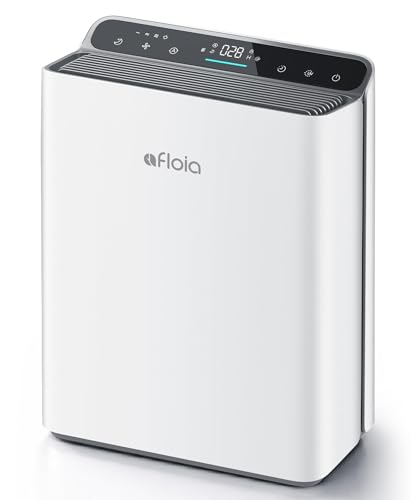
Afloia Air Purifier for Large Rooms Up to 2,000 Sq. Ft. with PM2.5 Display
- carbon stage
- washable pre-filter
- particle sensor
- auto mode
$79.99 Check pricePrices change often



Common questions
What CADR do I need for a 600 sq ft classroom?
About 540 CFM at 6 air changes an hour with a 9 foot ceiling. If two changes an hour suits your situation, 180 CFM is enough, and for smoke season at six changes you would want 540 CFM. The calculation is floor area times ceiling height times air changes divided by sixty.
Will a machine rated for a bigger room be better?
Usually yes, for one specific reason: a larger machine reaches the airflow you need at a lower fan speed, which is quieter and often uses less power than a small machine running flat out. The cost is a larger filter to replace. What does not follow is that a bigger coverage claim means a better filter.
Where should the purifier go in a classroom?
Somewhere with clear space around the intake and the outlet, away from a corner, and not tucked behind furniture. A machine that pulls in the air it has just cleaned is short circuiting and delivers far less than its rating suggests. Raising it off the floor a little also helps in rooms where the air is still.
Does running it on low all day work as well as high for an hour?
Not quite, because removal is exponential. Running continuously at a lower speed holds a lower steady concentration, which is generally what you want, while an hour on high clears a backlog fast and then lets it build again. For a classroom the usual answer is continuous at whatever speed you can live with.
Do I need the ionizer switched on?
No. The filtration is doing the work in any machine with a real filter in it, and an ionizer is an optional extra mode. Some ionizing and plasma type technologies produce ozone as a by-product, which is not something to add to an occupied room, so the sensible default is to leave that mode off.