The calculators
Quick answer
There are 5 calculators here and each one ships a worked answer in the page itself, so it works with JavaScript switched off. Each one can also refuse: when a room cannot be served by a single machine, or a humidity target would condense on the windows, they say so instead of returning the nearest number.

Genuine Winix Filter Q, 1712-0123-00 with Activated Carbon for Odor Control For Winix 5510, 5520 and 5530
A machine that publishes a figure you can compare against the answer, rather than a coverage area with no air change rate behind it.
Check the listing against the number a calculator gives you before buying.
Every calculator, with the answer it gives by default
- Required clean air delivery rate: 180 CFM
Room size to required CADR
Enter the floor area, the ceiling height and the air change rate you want, and get the clean air delivery rate a purifier has to publish to serve that room.
- 5 year cost of ownership: $549.00
Five year filter cost
The honest cost of a purifier: the machine plus every filter it will need over five years. A cheap unit with expensive proprietary filters is frequently the dearest option on the shelf.
- Capacity needed: 17 pints per day
Dehumidifier sizing
How many pints a day a space needs, by floor area and by how damp it genuinely is, on the 2019 DOE test conditions that current pint ratings use.
- Water needed: 3.48 gallons per day
Humidifier output sizing
How many gallons a day it takes to hold a room or a house at a target relative humidity, worked from the water balance rather than from a marketing room size.
- Air changes delivered: 6.25 per hour
How fast will it clear the room
Enter a machine's CADR and the room it is in, and get the air changes an hour it actually delivers and how long it takes to remove 90 and 99 percent of what is airborne.
The arithmetic behind all of them
Required clean air delivery rate equals floor area times ceiling height times air changes an hour, divided by sixty. Particle removal is exponential decay, so the time to remove a given fraction is the natural log of one over what remains, divided by the air change rate. Humidifier output is a water balance between the moisture you add and the moisture that leaves with the air.
None of that is proprietary and none of it is a rule of thumb. Every page that uses one of these shows the working, which is the point: a number you can check is worth more than a number you have to trust.
Equipment worth measuring against
- TempPro
TempPro TP50 Digital Hygrometer Indoor Thermometer Room Thermometer
$12.99 Check pricePrices change often - Govee
Govee Indoor Hygrometer Thermometer H5075 with Bluetooth App Control
- app or voice
$12.99 Check pricePrices change often - SMARTRO
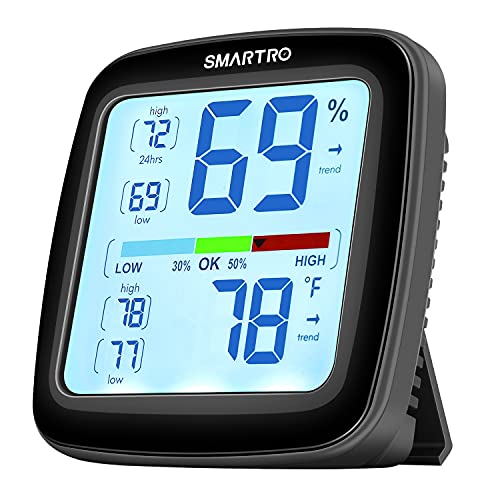
SMARTRO SC42 Professional Digital Hygrometer Indoor Room Thermometer
$18.99 Check pricePrices change often



Common questions
Do these work without JavaScript?
Yes. Every calculator is run at build time with its default inputs and the answer is written into the page as ordinary HTML, along with a plain statement of how it reaches that answer. JavaScript updates the result when you change an input and re-orders the product cards, all of which are present either way.
Why would a calculator refuse to answer?
Because some questions have no good answer. A large room at six air changes an hour may need more airflow than any single machine publishes, a humidity target can be above what the windows tolerate at that outdoor temperature, and a space with standing water has a drainage problem rather than a humidity one. Each refusal comes with what to do instead.
Where do the constants come from?
Published sources. The CADR arithmetic is unit conversion. The dehumidifier capacities are the published table for the 2019 DOE test conditions. The humidifier figures come from a water balance using standard psychrometric humidity ratios, with every assumption printed on the page.
Which calculator should I use first?
The sizing one, because the airflow a room needs decides which machines are even candidates. After that, the filter cost calculator is the one that most often changes the answer, since a cheap machine with proprietary filters frequently costs more over five years than a dearer one with an inexpensive annual filter.
Are the answers specific to my home?
No, and they cannot be. They are general arithmetic applied to numbers you enter. A real room has real doors, a real ventilation rate and real sources arriving while the machine removes them, and only somebody standing in it can account for all three.