Humidity sizing, both directions
Quick answer
Indoor relative humidity belongs between 30 and 50 percent. Above 60 percent supports mould and dust mites, and in cold weather anything above roughly 35 percent condenses on ordinary double glazing at 20 degrees Fahrenheit outside. Which machine you need depends on which side of that band the house sits, and a hygrometer answers that for the price of a takeaway.
Dehumidifier pint ratings on current labels are measured under the 2019 DOE test conditions, which are roughly thirty percent lower than the old test for the same physical machine.

Antonki 2 Pack Room Thermometer Indoor Hygrometer
A hygrometer tells you which direction the house actually needs, which is a different answer in different rooms and different seasons. It is the cheapest instrument on this site and the one that prevents the most expensive mistake.
Put it across the room from any machine, not beside it.
Dehumidifier capacity by floor area
Capacity is read from the published table for the 2019 DOE test conditions, by floor area and by how damp the space genuinely is. Guessing the dampness class upward is the common error, and an oversized machine cycles rather than drying steadily.
- 300 sq ft pints per day
- 400 sq ft pints per day
- 500 sq ft pints per day
- 600 sq ft pints per day
- 700 sq ft pints per day
- 800 sq ft pints per day
- 900 sq ft pints per day
- 1,000 sq ft pints per day
- 1,200 sq ft pints per day
- 1,400 sq ft pints per day
- 1,500 sq ft pints per day
- 1,600 sq ft pints per day
- 1,800 sq ft pints per day
- 2,000 sq ft pints per day
- 2,200 sq ft pints per day
- 2,500 sq ft pints per day
- 2,800 sq ft pints per day
- 3,000 sq ft pints per day
Humidifier output by floor area
Output is worked as a water balance rather than read off a marketing room size: cold dry air arrives by infiltration, is heated, and leaves carrying the moisture you added. The answer comes out in gallons a day, which is the figure that decides whether a tank will do.
- 100 sq ft gallons per day
- 150 sq ft gallons per day
- 200 sq ft gallons per day
- 250 sq ft gallons per day
- 300 sq ft gallons per day
- 400 sq ft gallons per day
- 500 sq ft gallons per day
- 600 sq ft gallons per day
- 700 sq ft gallons per day
- 800 sq ft gallons per day
- 900 sq ft gallons per day
- 1,000 sq ft gallons per day
- 1,200 sq ft gallons per day
- 1,500 sq ft gallons per day
- 2,000 sq ft gallons per day
- 2,500 sq ft gallons per day
- 3,000 sq ft gallons per day
Machines for both directions
- Levoit
Levoit Top Fill Humidifiers for Bedroom, 2.5L Tank for Large Room, 25dB
$29.79 Check pricePrices change often - DREO
DREO 3L Humidifiers for Bedroom, 30H Runtime, 26 dB Quiet, New Edition
$29.91 Check pricePrices change often - Levoit
Levoit Humidifiers for Bedroom, Quiet, 3L Cool Mist, Essential Oil Diffuser
$37.49 Check pricePrices change often - Vicks
Vicks Humidifier 3-in-1 SleepyTime Cool Mist Humidifier for Nursery, White
$37.97 Check pricePrices change often - Pure Enrichment
Pure Enrichment PureBaby Ultrasonic Cool Mist Humidifier
$39.99 Check pricePrices change often - Levoit
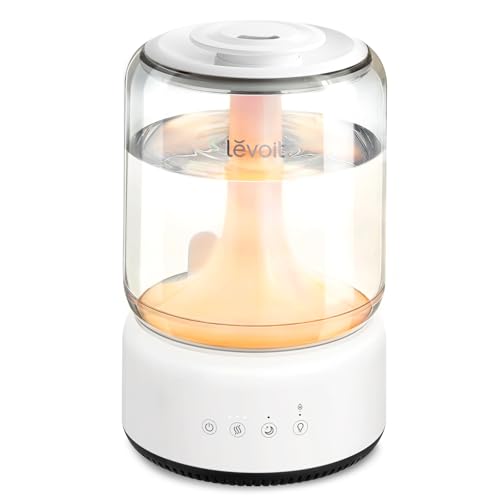
Levoit Humidifiers for Bedroom 4.2L Top Fill for Large Room, NeoClassic 450
$42.49 Check pricePrices change often


Common questions
What indoor humidity should I aim for?
Between 30 and 50 percent relative humidity. Above 60 percent is where mould and dust mites do well. In cold weather the binding limit is condensation rather than comfort: at 20 degrees Fahrenheit outside, about 35 percent indoors is as high as ordinary double glazing tolerates before water starts forming on the glass.
Why did dehumidifier pint ratings change?
The DOE test conditions changed in 2019 and now run at a lower chamber temperature, which is harder on the machine. The same physical unit sold as 70 pint before the change is labelled around 50 pints after it. Nothing about the machine changed, only the test, which is why an old sizing chart oversizes against a new label.
Do I need a dehumidifier or an air purifier?
They solve different problems. A dehumidifier removes water from the air, which is what stops mould growing and what makes a musty space smell normal again. A purifier removes particles already airborne, including spores, and does nothing about the moisture producing them. In a damp basement the dehumidifier comes first.
How much water does a humidifier actually need to add?
More than most tanks hold. Holding 1,000 square feet at 35 percent against 20 degree outdoor air takes roughly three and a half gallons a day, because dry air keeps arriving by infiltration and leaving with the moisture you added. That is the reason a tabletop machine in a large room never reaches its setting.
Where should the hygrometer go?
In the part of the space you are worried about, not beside the machine. Both humidifiers and dehumidifiers read the air arriving at their own intake, which after an hour of running is the least representative air in the room. A separate instrument across the room is what tells you what is actually happening.