Room size to required CADR
Quick answer
Required clean air delivery rate equals floor area times ceiling height times air changes an hour, divided by sixty. A 300 square foot room with an eight foot ceiling needs 180 CFM for four and a half air changes an hour and 80 CFM for two. The largest single machine in this site's catalog with a usable published airflow figure is 1333 CFM, and when a room needs more than that the calculator says so rather than recommending it anyway.
Compare this against a published CADR, ideally the smoke figure, which is the smallest particle size in the AHAM test and usually the lowest of the three numbers.
A coverage claim in square feet with no air change rate attached cannot be compared with this number, because the rate is the half of the claim that was left out.
The air change target is guidance, not a standard. The CADR figure it is compared against comes from the ANSI/AHAM AC-1 test method, which measures smoke, dust and pollen separately, so a machine carries three numbers rather than one.
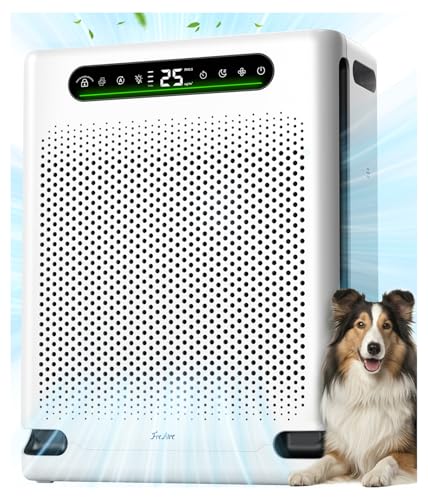
FreAire Air Purifiers for Home Large Room Up to 2600 Ft2, HAP605, White
A machine that publishes a figure you can actually compare against the answer above, rather than a coverage area with no air change rate behind it.
Prices and specifications change, so check the listing against the number this calculator gave you.
Purifiers with a published airflow figure
- MOOKA
MOOKA H13 HEPA Air Purifier for Home Pet Large Room Up to 1300ft2, Black
- HEPA claimed
- carbon stage
- has a UV lamp
$46.98 Check pricePrices change often - MOOKA
MOOKA Air Purifiers for Home Room up to 1076ft2, True HEPA Filter, B-D02L
- HEPA claimed
- carbon stage
$49.99 Check pricePrices change often - MOOKA
MOOKA Air Purifiers for Home Room up to 1076ft2, True HEPA Filter, B-D02L
- HEPA claimed
- carbon stage
$49.99 Check pricePrices change often - Clorox
Clorox Small Room Air Purifiers for Bedroom Home, True HEPA Filter
- HEPA claimed
$59.95 Check pricePrices change often - Frida
Frida Baby 3-in-1 Air Purifier, Sound Machine + Nightlight, Auto-Off Timer
- HEPA claimed
$59.97 Check pricePrices change often


Common questions
What is CADR?
Clean air delivery rate, in cubic feet per minute, measured under the ANSI/AHAM AC-1 test method in a sealed 1,008 cubic foot chamber. It is how much genuinely filtered air a machine delivers, which is not the same as how much air its fan moves. The test measures smoke, dust and pollen separately, so every machine has three CADR numbers.
Where does the two thirds rule come from?
It is a shopper's convention published by AHAM: look for a smoke CADR of at least two thirds of the room's floor area. It is the same arithmetic this calculator does, with an eight foot ceiling and five air changes an hour already chosen, because 8 x 5 / 60 works out at 0.667. It undersizes rooms with high ceilings.
How many air changes an hour do I need?
Two is the general comfort case. Four to five is the figure usually given for households where somebody reacts to pollen, dander or dust, and it is guidance rather than a measured threshold. Six or more is where smoke guidance sits, because smoke keeps arriving while the machine removes it.
Why does the calculator refuse some rooms?
Because for a large room at a high air change target, no single machine in the catalog publishes enough airflow to do it. Recommending the biggest one anyway would be selling a machine that cannot perform the job the reader described. Two units, a lower target, or a smaller closed off space are the honest answers.
Does a bigger machine in a small room hurt?
No, and it usually helps. A larger machine reaches the airflow you need at a lower fan speed, which is quieter and often uses less power than a small machine at full speed. The costs are the purchase price, the floor space and a larger filter to replace.