Pollen indoors: where it comes from and what helps
Quick answer
Pollen enters mainly through open windows, doors and clothing brought in from outside, and it settles fast compared to smoke or dust, so a bedroom-sized true HEPA purifier reduces the airborne count while the reader sleeps. A two pack bedroom unit like the one rated for 100 sq ft at $69.99 covers two rooms for close to the price of one larger unit.

2 Pack Air Purifier for Home Bedroom with H13 True HEPA Filter for Smoke, Smokers, Dust, Odors, Pollen, Pet Dander | Quiet 99.9% Removal to 0.1 Microns | White Available for California
Pollen exposure is highest overnight in the room a person spends the most consecutive hours in, and this true HEPA and carbon unit is rated for 100 sq ft, which covers a typical bedroom, and comes as a two pack so a second room, often a home office or a kid’s bedroom, gets covered for one purchase.
Coverage claims vary in what air change rate they assume, so check a published airflow figure against your own room rather than the room size on the box.
| Test aerosol | Typical size relative to the other two | Usual CADR result |
|---|---|---|
| Pollen | Largest of the three test particles | Usually the highest CADR number on a spec sheet |
| Dust | Middle size | Usually the middle CADR number |
| Smoke | Smallest of the three | Usually the lowest CADR number |
How does outdoor pollen actually get inside a house?
Pollen mostly rides in on the obvious paths: open windows and doors, air brought in through an HVAC system’s outdoor intake if it has one, and on clothing, hair and pets after time spent outside during a high pollen count. Compared with wildfire smoke or fine dust, pollen grains are relatively large, which means they settle out of the air faster once the source of new pollen is cut off.
That size difference is good news for filtration: larger particles are easier for any HEPA-rated media to capture, and they are also the reason keeping windows closed during the highest pollen hours of the day does more good per effort than it does for smaller particles like smoke.
Why start with the bedroom instead of the whole house?
A bedroom is the one room in most homes where a person spends seven or eight consecutive hours in the same air, which makes it the highest-value room to filter even in a house that cannot be fully covered. A correctly sized bedroom unit reduces the airborne pollen concentration through the entire time someone is asleep, when they are not moving between rooms and diluting the effect.
This is also the room where a smaller, quieter unit makes practical sense. A bedroom purifier does not need the CADR of a whole-house unit; it needs enough CADR for that one room’s square footage, plus a low enough noise level to run on a sleep setting overnight without being disruptive.
How much does a true HEPA purifier actually reduce airborne pollen?
Required CADR in CFM is floor area times ceiling height times air changes an hour, divided by sixty. For general allergy-related sizing, four to five air changes an hour is common guidance, not a published test standard; the two thirds rule most shoppers use, CADR at least two thirds of the floor area, is the same arithmetic worked out at an eight foot ceiling and five air changes an hour, since eight times five divided by sixty equals 0.667.
A purifier’s pollen CADR figure under AHAM AC-1, the published test standard behind that number, is usually the highest of the three CADR ratings on a spec sheet because pollen is the largest of the three test particle sizes and easiest for any HEPA-rated filter to capture. That means a unit that looks marginal on its smoke CADR often has real headroom on pollen.
What matters besides running a purifier during a high pollen season?
Keeping windows closed during the highest pollen hours, which for most plants is mid-morning through early afternoon, reduces the amount of new pollen entering in the first place. Changing clothes and showering before getting into bed keeps pollen carried in on hair and fabric from transferring directly into bedding, which otherwise becomes a source that sits close to the face all night regardless of what the purifier across the room is doing.
Washing bedding regularly during a heavy pollen stretch and keeping pets, which carry pollen on their fur after time outside, off the bed both reduce the load a purifier has to keep up with rather than replacing the purifier’s job entirely.
Does an air purifier need a carbon stage for pollen specifically?
No. Pollen is purely a particulate problem, and a true HEPA stage captures it without any help from activated carbon. Carbon matters for gas-phase problems like odor or VOCs, not for pollen, so a bedroom unit chosen for pollen control does not need to prioritize carbon mass the way a unit chosen for smoke or off-gassing would.
Equipment mentioned on this page
- Clorox
Clorox Small Room Air Purifiers for Bedroom Home, True HEPA Filter
- HEPA claimed
$59.95 Check pricePrices change often - Frida
Frida Baby 3-in-1 Air Purifier, Sound Machine + Nightlight, Auto-Off Timer
- HEPA claimed
$59.97 Check pricePrices change often - Afloia
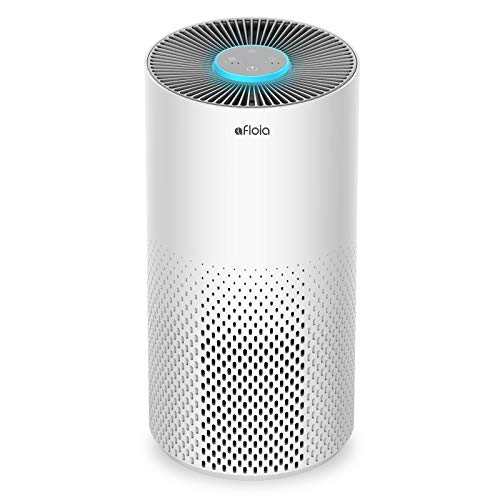
Afloia Air Purifier for Home Bedroom Large Room up to 1500 Sq Ft
- washable pre-filter
$59.97 Check pricePrices change often - Afloia
Afloia Air Purifier for Home Bedroom Large Room up to 1076 Sq Ft
$69.98 Check pricePrices change often - Levoit
Levoit Air Purifier for Home Pets Bedroom Dorm Room, Smart & Voice Control
- carbon stage
$69.99 Check pricePrices change often - Afloia
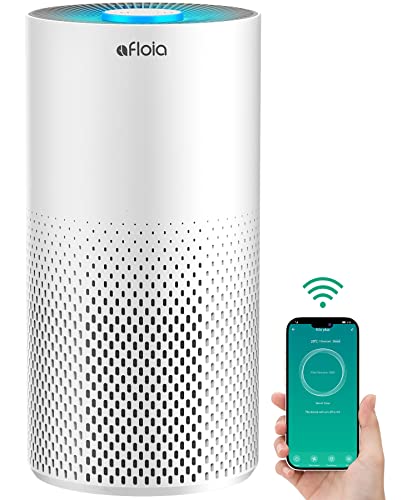
Afloia Smart Air Purifier for Home Large Rooms Bedroom, Up to 1,076 sq ft
- app or voice
$69.99 Check pricePrices change often




Common questions
Does an air purifier remove pollen from a whole house or just one room?
A single purifier only affects the room it is running in plus whatever air naturally mixes in from adjoining open spaces. It does not meaningfully reduce pollen in closed-off rooms elsewhere in the house. Covering multiple rooms means sizing and placing a unit for each one, which is why a bedroom-first approach targets the highest-value room before expanding.
Is a higher CADR number always better for a pollen-focused bedroom purifier?
Only up to the point that matches the room. A CADR far beyond what an 8 by 10 bedroom needs adds cost and often noise without additional benefit, since the room air is already being turned over multiple times an hour. Matching CADR to the two thirds rule or to a slightly higher four to five air change guidance covers the room without oversizing.
Do HEPA-type filters work as well as true HEPA for pollen?
True HEPA is tested to capture at least 99.97 percent of particles at its most penetrating size, a specific published standard. "HEPA-type" or "HEPA-like" filters are not held to that standard and typically capture less. For a particle as relatively large as pollen, a HEPA-type filter still does meaningful work, but true HEPA is the higher and verifiable bar.
Should the purifier run all night or only during the day?
Overnight is when a bedroom purifier does the most good, since that is the longest stretch of continuous, undisturbed time in the room. Running it on a lower or sleep-specific fan speed overnight still maintains a reduced airborne concentration while keeping noise low enough not to interfere with sleep, and leaving it running during the day as well keeps the room from drifting back up between sessions.
Does closing windows during a high pollen count actually make a measurable difference?
Yes, because it removes the largest and most direct source of new indoor pollen. Pollen grains are relatively large and settle fairly quickly once new pollen stops entering, so cutting off the source through closed windows lets a purifier maintain a lower concentration rather than continuously fighting fresh pollen coming in.
Does pet dander complicate a pollen-focused purifier setup?
It adds a second, unrelated particle source rather than complicating the pollen removal itself. True HEPA media captures both pollen and pet dander through the same mechanical filtration, so a unit sized for pollen in a pet household does not need a different filter type, just enough CADR to cover both sources without being undersized for either.