Air purifier running costs: power and filters
Quick answer
A small purifier drawing about 5 watts continuously costs roughly 7 dollars a year in electricity at a common residential rate of 0.16 dollars per kilowatt hour, while a larger unit drawing 60 to 70 watts at higher speeds runs closer to 85 to 100 dollars a year; in both cases, replacement filters are usually the bigger annual cost.

Clorox Small Room Air Purifiers for Bedroom Home, True HEPA Filter
This small-room unit is priced at $59.95, and its matching replacement filter is $19.99 with a stated 12 month life, so the full first-year cost is the purchase price plus one filter, with electricity a smaller line item on top.
Coverage claims vary in what air change rate they assume, so check a published airflow figure against your own room rather than the room size on the box.
| Class | Typical continuous draw | Estimated annual electricity cost |
|---|---|---|
| Compact / desk | about 5 watts | about $7 per year |
| Bedroom / medium | about 30 to 40 watts | about $42 to $56 per year |
| Large room | about 60 to 70 watts | about $84 to $98 per year |
The watts-to-dollars formula
Annual electricity cost equals watts divided by 1,000, times 24 hours, times 365 days, times the price per kilowatt hour. At $0.16 per kilowatt hour, a common residential rate, a machine drawing a steady 40 watts around the clock costs about 40 divided by 1,000, times 24, times 365, times 0.16, which works out to roughly 56 dollars a year.
These figures are typical draw for each class of machine at continuous operation, not a spec pulled from any single product listing, since most listings do not publish wattage. Actual draw varies by fan speed: a unit running mostly on a low or sleep speed most of the day, with occasional bursts to a higher speed, will land below the continuous high-speed estimate.
This is the same formula utilities use to bill any household appliance, and it scales linearly with both wattage and runtime: half the hours per day roughly halves the annual cost at the same wattage, and half the wattage roughly halves the cost at the same runtime. A purifier run for 12 hours a day rather than 24 costs roughly half of the continuous-operation figures in the table above, all else held equal. A household that only runs a purifier overnight in a bedroom, rather than around the clock, should apply this scaling directly rather than assuming the full 24 hour figures in the table describe their actual usage pattern.
Why fan speed changes the real number more than machine size
A large-room purifier running on its lowest speed most of the time can draw less power than a smaller machine forced to run at full speed to hit the same target air changes per hour in a room it is undersized for. This connects directly back to sizing: a correctly sized or slightly oversized machine, covered in `/guides/how-to-size-an-air-purifier/`, can run at a lower, cheaper speed and still deliver the target ACH, while an undersized machine has to run harder for the same result.
Auto mode, available on units with a particle sensor, further reduces average draw by dropping to a lower speed automatically when the air is already clean, rather than running at a fixed speed around the clock regardless of need.
This is also where the sizing headroom advice in `/guides/how-to-size-an-air-purifier/` pays off financially, not just acoustically: a unit sized with 20 to 30 percent more CADR than the strict minimum can spend most of its runtime on a lower, cheaper fan speed while still hitting the target air change rate, whereas a minimally sized unit has less room to back off the throttle and ends up drawing more power on average to deliver the same result.
What filters actually add to the yearly total
A true HEPA filter rated for 12 months at $19.99 to replace works out to roughly $1.67 a month, or about $20 a year, which is frequently a larger annual cost than the electricity to run the machine itself, particularly for smaller units with low power draw. Units with a combined HEPA and carbon filter, or larger filters for bigger rooms, commonly run $30 to $65 per replacement depending on the model and size, and a shorter stated filter life multiplies that per-replacement cost across more purchases per year.
A washable pre-filter does not eliminate this cost, but it extends the interval before the pricier HEPA or combined filter needs replacing by catching coarse debris first, which is covered in `/guides/washable-vs-replaceable-filters/`.
Larger units built for bigger rooms generally carry both a higher purchase price and a pricier filter, so the total cost gap between a compact and a large-room unit is wider than the purchase price difference alone suggests once a few years of filter replacements are added on top of it. This is worth weighing directly against the sizing guidance in `/guides/how-to-size-an-air-purifier/`: buying meaningfully more capacity than a room needs adds recurring filter cost every year, not just a one-time larger purchase price.
A worked first-year cost example
A small-room unit priced at $59.95 with a matching replacement filter at $19.99, rated for 12 months, costs $59.95 plus $19.99 in its first year of ownership before electricity is even added in, since the filter is due for its first swap right around the one-year mark. Adding a compact unit’s typical electricity draw of roughly 7 dollars a year brings the full first-year total to around 87 dollars, and every following year drops to roughly 27 dollars, the filter replacement plus electricity, once the one-time purchase price is out of the picture.
Running that same arithmetic against a listing’s actual purchase price and its matching filter price, rather than purchase price alone, is the more complete way to compare two machines that look similarly priced on the shelf but carry different filter costs behind them.
Comparing total cost of ownership across several years
Extending the same small-room example out to a third year of ownership, one purchase price plus three annual filter replacements plus three years of electricity, gives a running total that separates two units far more clearly than their shelf prices alone. A unit priced 15 dollars higher upfront but using a filter that lasts twice as long can end up meaningfully cheaper to own over three years than the cheaper-looking unit with a shorter filter interval.
This three-year framing is also a reasonable planning horizon for most households, since it roughly matches how long a purifier of this class tends to stay in active daily use before being replaced, upgraded, or moved to a secondary room. Running the comparison over one year alone tends to overweight the purchase price and underweight the filter cost that follows it.
Why the $0.16 per kilowatt hour figure is a starting point, not a fixed rate
Electricity rates vary meaningfully by region and by utility, and some areas run well above or below the $0.16 figure used in this page’s examples. A household on a higher-rate utility should scale every dollar figure in the electricity table proportionally: at $0.24 per kilowatt hour, half again higher than the example rate, the same 40 watt machine’s roughly 56 dollar annual estimate becomes closer to 84 dollars.
Time-of-use utility plans add another layer some households do not account for: running a purifier continuously through peak billing hours on a plan with a higher peak rate costs more than the flat-rate arithmetic in this page suggests, even at the same total kilowatt hours consumed. Checking a utility bill for whether a time-of-use structure applies is worth doing before assuming the flat $0.16 example rate reflects an actual household’s bill, and the same substitution applies to every dollar figure elsewhere on this page: swap in the actual local rate and the arithmetic still holds.
Equipment mentioned on this page
- Borgodf
Borgodf B-D02L/M05 Replacement Filter for MOOKA B-D02L & M05 Air Purifier
- HEPA claimed
- carbon stage
$17.98 Check pricePrices change often - Sinnya
12020 11020 HEPA Replacement Filter for Clorox Air Purifier 11020 & 11021
- HEPA claimed
$19.66 Check pricePrices change often - Cabiclean
Blue Pure Replacement Filter for Blueair 411, 411+, 411 Auto Air Purifier
- carbon stage
$19.89 Check pricePrices change often - Clorox
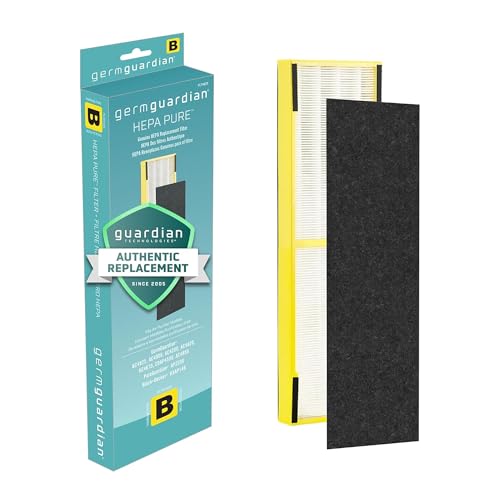
Clorox Tabletop Air Purifier True HEPA Replacement Filter, 200 Sq. Ft.
- HEPA claimed
$19.99 Check pricePrices change often - Rosekm
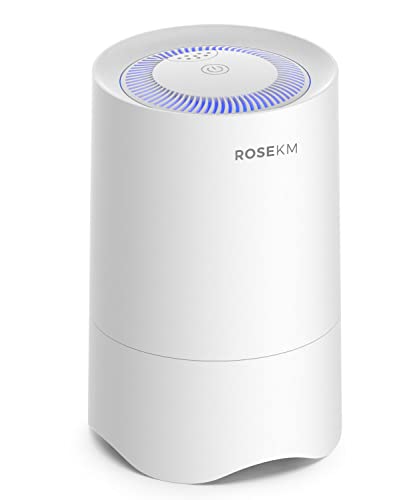
ROSEKM Small Air Purifier for Bedroom & Desk, 50 Sq Ft, H13 HEPA, White
- HEPA claimed
$19.99 Check pricePrices change often




Common questions
Is electricity or filters the bigger cost of running an air purifier?
For most units, filters are the larger annual cost. A 12 month HEPA filter at roughly 20 dollars often exceeds the electricity cost of running a small or medium purifier continuously for a year at a typical residential electricity rate, especially for lower-wattage compact and bedroom units.
How much does it cost to run an air purifier 24 hours a day?
At a common residential rate of $0.16 per kilowatt hour, a compact unit drawing about 5 watts costs roughly 7 dollars a year running continuously, while a large-room unit drawing 60 to 70 watts costs roughly 84 to 98 dollars a year. Actual cost depends on the specific unit’s wattage and how much time it spends at higher fan speeds.
Does running a purifier on auto mode save meaningful money?
Yes, for units with a particle sensor and auto mode, since the fan drops to a lower, lower-power speed when the sensor detects the air is already clean rather than running at a fixed higher speed continuously. The savings scale with how much of the day the room’s air is actually clean.
How do I calculate the running cost for my specific electricity rate?
Use watts divided by 1,000, times 24, times 365, times your own rate per kilowatt hour, in place of the $0.16 example rate used on this page. Your utility bill states the actual rate per kilowatt hour for your area, which can be meaningfully higher or lower than the national average figure used here.
Do bigger purifiers always cost more to run than smaller ones?
Not necessarily. A correctly sized large unit running at a low fan speed can draw less power than an undersized small unit forced to run at full speed continuously to try to hit the same target air changes per hour, since fan speed affects draw more than the machine’s rated coverage size alone.
Should I factor filter cost into which purifier I buy?
Yes. Two units at a similar purchase price can have very different total costs of ownership if one uses a $20 annual filter and the other uses a $50 filter needing replacement every 6 months. `/tools/filter-cost-calculator/` runs this comparison across multiple units.