How to size an air purifier for a room
Quick answer
Multiply floor area by ceiling height by your target air changes per hour, then divide by 60, to get the minimum smoke CADR in CFM the machine needs; a 150 square foot bedroom at an 8 foot ceiling and 5 ACH needs about 100 CFM.

LEVOIT Smart Air Purifiers for Home Large Room Up to 1733 Ft2 Core 400S-P
The listing states a smoke CADR of 231 CFM against a 1,733 square foot coverage claim, real enough numbers to run through the sizing formula and check whether the coverage claim and the CADR figure actually agree.
Coverage claims vary in what air change rate they assume, so check a published airflow figure against your own room rather than the room size on the box.
| Room | Floor area | Target ACH | Minimum smoke CADR needed |
|---|---|---|---|
| Small bedroom | 120 sq ft | 4 | 64 CFM |
| Standard bedroom | 150 sq ft | 5 | 100 CFM |
| Living room | 300 sq ft | 4 | 160 CFM |
| Open-plan living/kitchen | 500 sq ft | 3 | 200 CFM |
Step one: measure the actual floor area and ceiling height
Measure the room’s floor area in square feet and note the ceiling height. Most sizing charts assume an 8 foot ceiling by default; a room with a 9 or 10 foot ceiling, or a vaulted ceiling, holds meaningfully more air volume than the same floor area at 8 feet, and skipping this step is the single most common sizing mistake.
For an open floor plan connecting a living room and kitchen, measure the combined area if the space shares air freely with no door separating them, since the purifier has to handle the full connected volume, not just the section it sits in.
An irregularly shaped room, an L-shaped layout or a room with an alcove, still uses the same total floor area figure; break it into rectangular sections, calculate each one’s square footage separately, and add them together rather than trying to estimate the combined shape by eye. A tape measure or a laser distance measurer removes the guesswork here, and the accuracy of every later step in the formula depends on getting this first number right.
Step two: choose a target air change rate, and know it is guidance
2 air changes an hour is a light baseline GUIDANCE figure for a room with no particular complaint. 4 to 5 ACH is common GUIDANCE for allergy-sensitive households or homes with pets. 6 ACH or higher is used for active wildfire smoke, cigarette smoke, or high-occupancy rooms. None of these numbers come from a published standard; they are recommended targets, and choosing the right one for a specific room is a judgment call based on the actual problem in that room.
`/guides/air-changes-per-hour/` covers where these guidance figures come from and the decay math behind them in more depth.
Picking between these targets is really a question about the actual problem in the room, not a preference for a bigger number. A guest room used occasionally has little reason to be sized for 6 ACH; a bedroom shared with a pet that sheds heavily, or a room where someone spends most waking and sleeping hours, has a stronger case for the higher end of the range. Matching the target to the actual situation avoids both an undersized purchase and paying for capacity the room does not need.
Step three: solve for the required CADR
Required CADR in CFM equals floor area times ceiling height times target ACH, divided by 60. A 150 square foot bedroom at an 8 foot ceiling, targeting 5 ACH, needs 150 times 8 times 5 divided by 60, which is 100 CFM of smoke CADR. A 300 square foot living room at a 9 foot ceiling, targeting 4 ACH, needs 300 times 9 times 4 divided by 60, which is 180 CFM.
Use the smoke CADR figure, the lowest and most conservative of a machine’s three CADR numbers, when checking whether a specific unit clears this bar. `/tools/cadr-calculator/` runs this exact formula for any floor area, ceiling height, and target ACH combination.
It is worth doing this arithmetic before opening a shopping page rather than after, since knowing the actual CFM number needed lets you filter listings by their stated smoke CADR directly rather than scanning square footage claims that, as covered in `/guides/cadr-explained/`, do not always disclose the air change rate behind them. A specific CFM target turns an open-ended search for "a good purifier" into a checkable pass or fail test against any listing’s stated numbers.
Step four: check the manufacturer’s coverage claim against the actual CADR
A coverage claim in square feet is only meaningful alongside the air change rate it assumes, and many listings do not state that assumption. Where a listing does state its air change basis, or states a smoke CADR directly, run that CADR figure back through the formula at your own target ACH rather than trusting the printed square footage number, since the manufacturer may have assumed a lower ACH than the one that fits your situation.
A unit advertised as covering 1,733 square feet at whatever ACH the manufacturer assumed might only cover 350 square feet at 5 ACH; the CADR number is fixed, but the "coverage" claim built on top of it moves depending on which air change rate gets plugged in.
This is the exact case worth checking against the topPick example above: a smoke CADR of 231 CFM run through the formula at a target 5 ACH and an 8 foot ceiling supports roughly 350 square feet, not the larger coverage figure a listing might lead with elsewhere on the same page. Neither number is wrong; they simply describe the same CADR figure at two different air change rates, and the lower, stricter one is the more useful figure for an allergy-sensitive household.
Step five: size up rather than down when the room is borderline
A purifier rated close to the exact CFM required has to run at or near its top speed continuously to hit the target ACH, which means more noise and less headroom for a room that turns out larger than measured, has poor air mixing, or gets a closed door added later. Sizing to a machine with somewhat more CADR than the formula requires lets it run at a lower, quieter speed while still delivering the target air change rate.
This tradeoff is placement and noise, not a change to the underlying arithmetic: a bigger machine at a lower fan speed and a smaller machine at full speed can deliver the same actual CADR, but the bigger machine gets there more quietly.
A reasonable rule of thumb is to size to a unit whose smoke CADR is 20 to 30 percent above the strict minimum the formula returns, which gives enough headroom to run at a mid or lower fan speed rather than the top setting, without paying for dramatically more capacity than the room will ever use. `/guides/air-purifier-noise-levels/` covers how fan speed and decibel ratings interact with this same headroom decision.
What sizing cannot fix
No amount of correct sizing math compensates for a machine placed in a corner behind furniture, blocking its intake or output, or for a room with a strong, continuous particle source like an attached garage or an unsealed crawlspace. Sizing gets the CADR number right; placement and source control determine whether that CADR number is actually being delivered into the room’s breathing zone. `/guides/where-to-place-an-air-purifier/` covers the placement half of this problem.
Sizing also does not account for a filter that is loaded and restricting airflow, which reduces real-world CADR below the rated figure regardless of how carefully the room was measured and the formula applied. Getting the sizing math right is a necessary first step, not a one-time fix that guarantees performance for the life of the machine; filter condition and placement both need ongoing attention alongside it.
Equipment mentioned on this page
- MOOKA
MOOKA H13 HEPA Air Purifier for Home Pet Large Room Up to 1300ft2, Black
- HEPA claimed
- carbon stage
- has a UV lamp
$46.98 Check pricePrices change often - MOOKA
MOOKA Air Purifiers for Home Room up to 1076ft2, True HEPA Filter, B-D02L
- HEPA claimed
- carbon stage
$49.99 Check pricePrices change often - MOOKA
MOOKA Air Purifiers for Home Room up to 1076ft2, True HEPA Filter, B-D02L
- HEPA claimed
- carbon stage
$49.99 Check pricePrices change often - Clorox
Clorox Small Room Air Purifiers for Bedroom Home, True HEPA Filter
- HEPA claimed
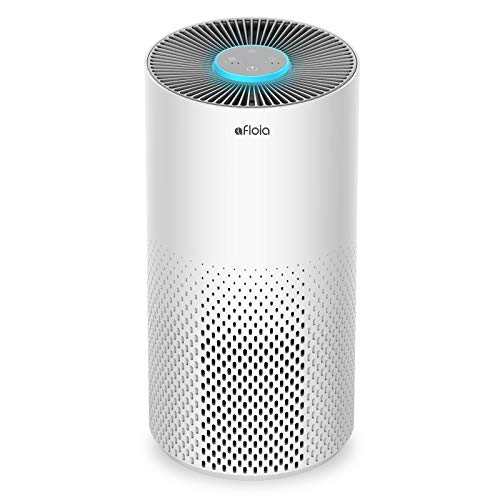
$59.95 Check pricePrices change often - Afloia
Afloia Air Purifier for Home Bedroom Large Room up to 1500 Sq Ft
- washable pre-filter
$59.97 Check pricePrices change often


Common questions
What size air purifier do I need for a 150 square foot bedroom?
At an 8 foot ceiling and 5 air changes an hour, a 150 square foot bedroom needs about 100 CFM of smoke CADR. At a lighter 2 ACH baseline, the same room only needs about 40 CFM. Which target to use depends on whether allergies, pet dander, or general baseline air quality is the actual goal.
Do I need to account for furniture when measuring floor area?
No. Floor area for this formula is the room’s total square footage, not the open floor space around furniture. Furniture placement matters for where you position the purifier so its intake and output are not blocked, which is a separate placement question from the sizing arithmetic.
How do I size a purifier for an open-plan living room and kitchen?
Measure the combined floor area of both connected spaces if no door separates them, since air moves freely between them and the purifier has to handle the full shared volume. Treating only the living room portion as the target room will undersize the machine for the actual space it needs to clear.
Should I size for the smoke CADR, dust CADR, or pollen CADR?
Use the smoke CADR, which is almost always the lowest and most conservative of a machine’s three CADR numbers. Sizing to the lowest number means the machine still clears the target air change rate for the harder-to-remove particle sizes, with dust and pollen removal coming in faster than that baseline.
What if my ceiling is higher than 8 feet?
A taller ceiling increases the room’s air volume for the same floor area, which raises the required CADR proportionally. A 9 foot ceiling needs about 12.5 percent more CADR than an 8 foot ceiling at the same floor area and target ACH; run the actual ceiling height through the full formula rather than the 8 foot shortcut.
Is it better to buy one large purifier or two smaller ones for a big room?
Either can reach the same total required CADR, but two smaller units placed at opposite ends of a large or oddly shaped room can improve air mixing and reduce the short-circuiting that happens when one machine has to pull air across the entire space. `/guides/where-to-place-an-air-purifier/` covers this placement tradeoff in more depth.