How to read an air quality monitor
Quick answer
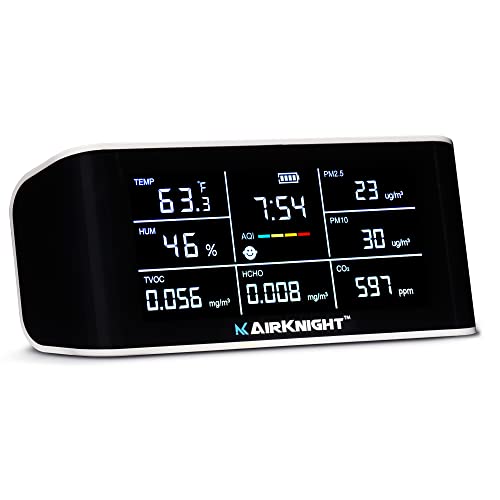
PM2.5 measures fine particulate concentration, carbon dioxide measures ventilation and how stale a room’s air is, and VOC index measures relative changes in a mix of gases rather than any single named chemical, and a budget sensor can track trends reliably even when its absolute numbers are not lab-grade accurate.

Aranet4 Indoor Air Quality Monitor, Wireless CO2 Detector for Home, Office
The Aranet4 uses a dedicated NDIR CO2 sensor, a more accurate and more expensive measurement approach than the combined metal-oxide sensors used in most budget all-in-one monitors, and its listing states this specifically rather than folding CO2 into a generic "air quality" score.
Coverage claims vary in what air change rate they assume, so check a published airflow figure against your own room rather than the room size on the box.
| Reading | What it measures | What it does not measure |
|---|---|---|
| PM2.5 | Fine particulate mass concentration in the air | Particle source or type, like smoke versus dust |
| CO2 | Carbon dioxide concentration, a proxy for ventilation | Other gases, VOCs, or particulate matter |
| VOC index | Relative shift in a mixed group of volatile compounds | The identity or concentration of any single named chemical |
What PM2.5 actually tells you
PM2.5 refers to particulate matter 2.5 microns or smaller in diameter, small enough to stay suspended in air for extended periods rather than settling quickly. A PM2.5 sensor reports a mass concentration, typically in micrograms per cubic meter, and rising or falling numbers over time in the same room are a directly useful, measurable signal of whether particulate levels are increasing or decreasing.
A PM2.5 reading does not identify the source; smoke, dust, cooking particles, and outdoor pollution infiltrating through a window all register on the same scale. Watching a PM2.5 number spike right after cooking or right after opening a window during a smoke event is a useful diagnostic even without knowing the exact particle type.
Most consumer PM2.5 sensors use a low-cost laser or optical scattering method, which is genuinely useful for tracking relative changes but is generally less precise than the gravimetric reference method used in regulatory air quality monitoring. This gap in absolute precision rarely matters for the household question this page is concerned with, whether a specific room’s air is getting better or worse over time, since that question depends on the trend rather than the exact number.
Humidity also affects some low-cost optical PM2.5 sensors, since water droplets in very humid air can scatter light in a way the sensor misreads as particulate matter, inflating the reported number during a humid spell without an actual increase in dust, smoke, or pollen. A PM2.5 spike that coincides with a sudden jump in humidity, rather than an obvious source like cooking or an open window, is worth treating with a bit of skepticism for this reason.
What CO2 actually tells you
Carbon dioxide concentration in an occupied room rises with the number of people present and the amount of fresh outdoor air being exchanged in, which makes CO2 a widely used proxy for ventilation rate rather than a pollutant tracked for its own sake at typical indoor levels. A rising CO2 reading in a closed bedroom overnight, for example, indicates the room is not getting fresh air exchange, independent of anything to do with particulate or VOC levels.
Dedicated CO2 sensors commonly use NDIR (non-dispersive infrared) technology, which is generally more accurate and more expensive than the metal-oxide sensors bundled into many budget all-in-one monitors; a listing that specifically states NDIR CO2 sensing is disclosing a different, more reliable measurement approach than one that only lists a generic multi-gas sensor.
A cheaper alternative some budget monitors use is an "eCO2" or estimated CO2 reading, calculated indirectly from a VOC sensor rather than measured directly, which is a meaningfully different and less reliable approach than a true, direct CO2 measurement. A listing that distinguishes between "CO2" and "eCO2" is disclosing a real difference in measurement method, not just marketing language, and the direct CO2 reading is the more trustworthy of the two for the ventilation-tracking purpose this section describes. Checking a listing’s specification sheet for which of the two terms it actually uses is worth the extra minute before assuming a "CO2 monitor" is measuring CO2 directly.
What a VOC index actually is, and what it is not
A VOC index reported by most consumer monitors is a relative score representing a shift in the combined signal from a broad group of volatile organic compounds, not a measurement of a specific named chemical like formaldehyde or benzene at a stated concentration. The sensor reacts to a mixture of gases together and reports a single index number that moves up or down as that mixture changes.
This makes a VOC index genuinely useful for noticing when something changed, a new paint smell, cleaning product use, or off-gassing from new furniture, but it cannot answer "how much formaldehyde is in this room" on its own. A dedicated formaldehyde or specific-gas meter, a separate and typically more expensive instrument, is required to answer that narrower question.
Different manufacturers also scale their VOC index numbers differently, so a reading of, for example, 150 on one brand’s monitor is not necessarily comparable to a 150 reading on a different brand’s device, even though both are called a VOC index. This makes VOC index most useful as a same-device, same-room trend indicator rather than a number to compare across two different monitors from different manufacturers.
What a cheap sensor can and cannot do
A budget all-in-one monitor combining PM2.5, CO2, and VOC sensing in one device is generally reliable for tracking relative trends in the same room over time: is the number going up or down compared to an hour ago, or compared to before and after turning on a purifier. Budget sensors are less reliable for precise absolute accuracy compared to laboratory-grade or dedicated single-purpose instruments, particularly for CO2 measured with a metal-oxide sensor rather than NDIR, and for VOC index, which by design is a relative rather than absolute figure.
For most household purposes, particularly checking whether a purifier is actually reducing PM2.5 in a specific room, or whether a bedroom needs better ventilation based on rising overnight CO2, a budget monitor’s trend data is genuinely useful even without laboratory precision.
Sensor drift is a real, if usually gradual, limitation worth knowing about: most consumer sensors lose a small amount of calibration accuracy over months of continuous use, and a monitor that reported accurately when new may read somewhat differently a year or two later. Manufacturers vary in whether they support recalibration, and checking this before buying matters more for a household planning to rely on the monitor’s absolute numbers over a long period than for one mainly watching short-term before-and-after trends.
Using a monitor alongside a purifier, not instead of one
A monitor measures air quality; it does not change it. Pairing a PM2.5 reading with the sizing and placement guidance in `/guides/how-to-size-an-air-purifier/` and `/guides/where-to-place-an-air-purifier/` turns a monitor from a passive number on a screen into a way to actually verify whether a specific purifier setup is working in a specific room, before and after running it.
A practical routine worth adopting: note the PM2.5 reading before turning the purifier on, then check again after roughly the time predicted by the 90 percent clearance formula, ln(10) divided by the room’s ACH, in hours, covered in `/guides/air-changes-per-hour/`. A reading that drops close to the predicted amount confirms the setup is performing close to its sizing math; a reading that barely moves is a signal to check placement, filter condition, or whether the room is actually as sealed as assumed.
Equipment mentioned on this page
- GoveeLife
GoveeLife Smart Air Quality Monitor with PM2.5 H5106, LED Display Wired
- app or voice
$45.99 Check pricePrices change often - LifeBasis
LifeBasis Air Quality Monitor Indoor, 11-in-1 Air Quality Detector
- particle sensor
$61.69 Check pricePrices change often - YNAK
16 in 1 Air Quality Monitor Indoor 7" High-Precision Real-Time CO2 Monitor
- particle sensor
$89.99 Check pricePrices change often - BREATHE
BREATHE Airmonitor Plus Indoor Air Quality Monitor w/CO, PM & App. Gen 2.
- app or voice
$99.99 Check pricePrices change often



Common questions
What is a good PM2.5 reading for indoor air?
Lower is generally better, with readings commonly described as good staying in the single digits to low teens in micrograms per cubic meter, though specific health-based thresholds vary by source. The more directly useful practice is tracking a room’s own trend over time rather than fixating on a single absolute number from a budget sensor.
What CO2 level indicates a room needs more ventilation?
CO2 concentrations climbing well above typical outdoor ambient levels, often cited starting around 1,000 parts per million and higher in occupied indoor guidance, are commonly used as a signal that a room is not getting enough fresh air exchange for the number of people in it. Watching the trend rise over the course of a night or a meeting is more informative than a single spot reading.
Can a VOC index tell me exactly what chemical is in my air?
No. A VOC index is a relative score reflecting a shift across a mixed group of volatile compounds, not an identification or concentration reading for any single named chemical. A dedicated formaldehyde or specific-gas meter is a separate instrument required to answer that more specific question.
Are budget air quality monitors accurate?
They are generally reliable for tracking relative trends in the same location over time, less reliable for precise absolute accuracy compared to dedicated single-purpose or laboratory-grade instruments. A budget CO2 sensor using metal-oxide technology, for example, is typically less accurate than a dedicated NDIR CO2 sensor.
Why does my monitor show different numbers than a friend’s in a similar room?
Sensor technology, calibration, and placement all affect readings, and a metal-oxide-based sensor and an NDIR-based sensor can report meaningfully different numbers for the same gas concentration. This is a real limitation of budget consumer monitors and is one reason tracking a single device’s own trend matters more than comparing absolute numbers across different monitors.
Should I buy a combined monitor or separate dedicated sensors?
A combined all-in-one monitor is more convenient and cheaper for general trend-watching across PM2.5, CO2, and VOC index together. Separate dedicated sensors, such as a standalone NDIR CO2 monitor or a radon detector, are worth the added cost when a specific gas or hazard needs a more accurate, verified reading.