Cigarette smoke indoors: what filtration can and cannot do
Quick answer
Filtration does not make indoor smoking safe: it can reduce the measured airborne particulate and some of the gas-phase compounds while a true HEPA and activated carbon unit runs, but residue settles into fabric, walls and surfaces regardless, and no filter reaches that. The PuroAir 240, rated for 1,000 sq ft at $159.99, combines both stages for the airborne portion of the problem.
Smoking outdoors, away from doors and windows, reduces indoor exposure far more than any filtration setup run indoors.

PuroAir 240 HEPA Air Purifiers for Home Pets Bedroom - 1,000 Ft2
Tobacco smoke is a combined particulate and gas problem, so a unit needs both true HEPA and a real activated carbon stage to do anything meaningful, and the PuroAir 240 has both in a 1,000 sq ft rated package that suits a single room where smoking has occurred.
Coverage claims vary in what air change rate they assume, so check a published airflow figure against your own room rather than the room size on the box.
| Component | What it is | What removes it |
|---|---|---|
| Airborne particulate matter | Fine and ultrafine particles suspended in the room while smoke is fresh | True HEPA filtration, while it is still airborne |
| Gas-phase compounds | Volatile chemicals released alongside the visible smoke | Activated carbon adsorption, if the carbon has not saturated |
| Residue on surfaces (thirdhand smoke) | Compounds that settle into fabric, walls, carpet and furniture | Nothing a purifier does; requires cleaning, and sometimes replacing porous materials |
Does an air purifier make it safe to smoke indoors?
No, and it is worth saying plainly rather than hedging: no air purifier, regardless of CADR or filter quality, makes indoor smoking safe. Filtration can reduce the measured concentration of airborne particulate and some gas-phase compounds while it runs, but it does not eliminate exposure, does not reach the compounds that settle into surfaces, and stops helping the moment the unit is turned off or the room is entered before it has had time to clear.
This page exists to explain what filtration actually does in this situation, not to suggest it turns indoor smoking into a low-exposure activity. Smoking outdoors, away from open doors and windows, reduces indoor exposure by a wider margin than any filtration setup possibly can.
What is actually in cigarette smoke that matters for indoor air?
Tobacco smoke is unusual among the problems on this site because it is both a heavy particulate source and a heavy gas-phase source at the same time, releasing fine and ultrafine particles alongside a wide range of volatile chemical compounds in the same burst. That combination is why a purifier needs both a genuine true HEPA stage and a substantial activated carbon stage to do anything meaningful here; a HEPA-only unit misses the entire gas-phase half of the problem, and a carbon-only approach misses the particulate half.
What does a true HEPA and carbon purifier actually reduce?
While it is running, a properly sized unit reduces the measured airborne particulate concentration and adsorbs a portion of the gas-phase compounds onto its activated carbon, for as long as that carbon has capacity left. Both effects only apply to what is currently in the air; neither reaches compounds that have already settled onto walls, fabric, carpet or furniture, sometimes referred to as thirdhand smoke, which continues to off-gas slowly over a much longer timeframe than the original smoke event.
Because tobacco smoke is a heavier, more concentrated source than most of the other problems covered on this site, a room where regular indoor smoking has occurred generally needs a larger CADR and more frequent carbon replacement than the same room would need for something like cooking odor or pet dander.
Why does the smell linger even after the smoke itself has cleared and the purifier has run for hours?
The lingering smell after visible smoke has cleared is largely thirdhand residue: compounds that have absorbed into porous materials like fabric, carpet, drywall and curtains, and that continue releasing odor slowly over an extended period. A purifier only ever addresses what is airborne at a given moment, so it cannot reach residue embedded in a couch cushion or a wall, no matter how long it runs or how much carbon it has.
This is also why a carbon filter in a room with a history of regular smoking saturates faster than the same filter would in a room without that history: it is working against both fresh gas-phase compounds and the slow, continuous off-gassing of settled residue at the same time.
What actually reduces exposure more than any purifier can?
Not smoking indoors at all is the single change that reduces exposure the most, by a wide margin over any filtration approach. Where that is not an option, smoking in one dedicated, well-ventilated room with the door kept closed to the rest of the house limits how far particulate and gases spread, and cleaning fabric, carpet and hard surfaces regularly removes settled residue that no purifier reaches. Repainting and replacing heavily affected porous materials, like old carpet or curtains, is sometimes the only way to fully resolve a persistent smell from a long smoking history.
Equipment mentioned on this page
- MOOKA
MOOKA H13 HEPA Air Purifier for Home Pet Large Room Up to 1300ft2, Black
- HEPA claimed
- carbon stage
- has a UV lamp
$46.98 Check pricePrices change often - MOOKA
MOOKA Air Purifiers for Home Room up to 1076ft2, True HEPA Filter, B-D02L
- HEPA claimed
- carbon stage
$49.99 Check pricePrices change often - MOOKA
MOOKA Air Purifiers for Home Room up to 1076ft2, True HEPA Filter, B-D02L
- HEPA claimed
- carbon stage
$49.99 Check pricePrices change often - Clorox
Clorox Small Room Air Purifiers for Bedroom Home, True HEPA Filter
- HEPA claimed
$59.95 Check pricePrices change often - Afloia
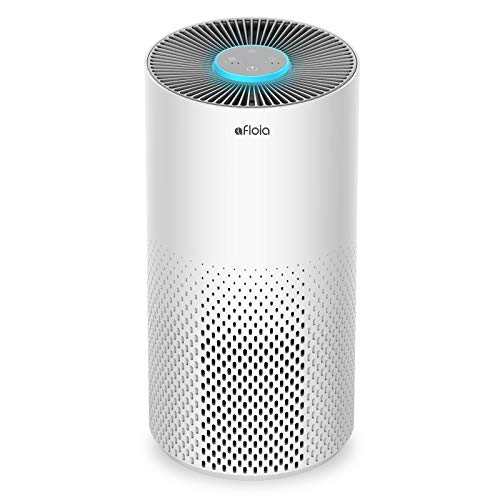
Afloia Air Purifier for Home Bedroom Large Room up to 1500 Sq Ft
- washable pre-filter
$59.97 Check pricePrices change often


Worth knowing before you buy
Common questions
Can an air purifier fully remove the smell of cigarette smoke from a room?
Not on its own, especially after smoking has happened repeatedly over time. A purifier reduces airborne particulate and some gas-phase compounds while it runs, but the smell that lingers afterward mostly comes from residue absorbed into fabric, carpet and walls, which filtration does not reach. Cleaning and, in some cases, replacing affected materials is needed alongside filtration.
Does filtration reduce the health risk of secondhand smoke to a safe level?
No air purifier reduces indoor smoking exposure to a safe level. Filtration lowers the measured concentration of some airborne particulate and gases while it is running, but it does not eliminate exposure, does not reach settled residue, and provides no protection during the period before the purifier has had time to clear the room.
How much bigger a purifier is needed for a room with regular indoor smoking compared to typical use?
Meaningfully bigger, since tobacco smoke is a heavier combined particulate and gas source than most other indoor problems. Sizing toward the higher end of available CADR for the room’s square footage, and replacing the activated carbon stage more often than the standard interval, both help keep pace with a regular smoking habit.
What is thirdhand smoke, and why does a purifier not address it?
Thirdhand smoke refers to tobacco residue that settles onto surfaces like walls, furniture, carpet and clothing after the visible smoke has cleared, and it continues releasing compounds slowly over time. A purifier only filters air that is currently airborne inside the unit, so it has no mechanism for removing residue already absorbed into a surface.
Does opening a window help more than running a purifier during and after smoking indoors?
Both help in different ways: opening a window ventilates and dilutes both particulate and gases with outdoor air, while a purifier continues working on remaining indoor air even after a window is closed again. Neither substitutes for not smoking indoors, and using both together clears a room faster than either alone.
How often should the carbon filter be replaced in a purifier used in a room where people smoke?
More frequently than the manufacturer’s general interval, since tobacco smoke is a heavier gas-phase load than typical household air and saturates activated carbon faster than it would in an average room. A noticeable return of odor before the scheduled replacement date is a reliable sign the carbon has reached capacity and needs changing sooner, and tracking that pattern over a few cycles gives a more realistic interval than the box’s default number.