Humidity and condensation: two problems, two machines
Quick answer
Indoor relative humidity too low causes static, cracking and dry skin; too high supports mold and dust mites; both sit outside the general 30 to 50 percent target band, and in cold weather that safe ceiling drops further to avoid window condensation. A cheap hygrometer like the Govee H5075, $12.99, is the first purchase, because it tells you which direction the problem actually is before buying either a humidifier or a dehumidifier.

Govee Indoor Hygrometer Thermometer H5075 with Bluetooth App Control
Before buying a humidifier or a dehumidifier, the actual number matters more than the guess: this hygrometer reads relative humidity directly and logs it over time through its app, which is what tells a household whether they are dealing with a too-dry problem, a too-damp problem, or a room that is already fine and does not need either machine.
Coverage claims vary in what air change rate they assume, so check a published airflow figure against your own room rather than the room size on the box.
| Outdoor temperature | Commonly published indoor RH ceiling |
|---|---|
| Above 40°F | Around 45% |
| 20°F to 40°F | Around 35% to 40% |
| 0°F to 20°F | Around 25% to 30% |
| Below 0°F | Around 15% to 20% |
What are the two directions a humidity problem can go?
Indoor humidity that is too low brings static shocks, cracking wood furniture and floors, and dry skin and sinuses, especially common in winter when cold outdoor air holding little moisture gets heated indoors and its relative humidity drops further. Indoor humidity that is too high supports mold growth and dust mite populations and can lead to condensation on windows and inside wall cavities. These are opposite problems with opposite causes, and treating one with the tool meant for the other does nothing, or makes things worse.
Indoor relative humidity belongs between 30 and 50 percent for most homes most of the year. Below 30 percent, a home is on the dry side; above 50 percent, and especially above 60 percent, mold and dust mite risk climbs.
Why does the safe humidity ceiling drop when it gets cold outside?
Condensation forms when humid indoor air meets a cold surface, most commonly a window pane or the inside of an exterior wall, and cools below its dew point right at that surface. In cold weather, window surfaces run much colder than room air, so even humidity that sits comfortably inside the 30 to 50 percent band during milder weather can condense on glass once outdoor temperatures drop far enough. This is why the safe indoor humidity ceiling is not a fixed number year-round; it drops as outdoor temperature drops, which is guidance drawn from how condensation physics works at the window surface, not a fixed test standard.
A household running a humidifier through the coldest stretch of the season without accounting for this can end up with condensation and eventually mold growth around window frames, from a source that looks unrelated to a humidity setting until the connection is made.
Which machine actually solves which direction?
A humidifier adds moisture to raise relative humidity, which is the fix for a too-dry home; a dehumidifier removes moisture to lower relative humidity, which is the fix for a too-damp one. Running a humidifier in an already-damp basement raises mold and dust mite risk further, and running a dehumidifier in an already-dry bedroom adds unnecessary noise and cost while making the dryness worse. The direction has to be established first, which is exactly what a hygrometer is for.
A console evaporative humidifier, like a unit rated for 1,000 sq ft at $109.99, covers a larger space efficiently but needs its wick filter replaced periodically, typically around $18.19 for a two pack, to keep working without spreading mineral buildup into the air. A compressor dehumidifier sized for a damp space, such as a 34 pint unit rated for 2,000 sq ft at $165.98, works the other direction entirely and needs no wick, just periodic tank emptying or a drain hose.
Why does a dehumidifier’s pint rating not mean what it used to?
Dehumidifier pint ratings changed with the 2019 DOE test conditions, and the same physical machine that used to be sold and labeled as a 70 pint unit is now commonly labeled around 50 pints under the current standard. Comparing an older capacity chart or an older unit’s label against a current model’s pint rating without accounting for that change leads to buying a unit that is smaller in actual moisture removal capacity than the number suggests. Checking the manufacture date or looking specifically for current Energy Star certification avoids this trap.
How do you actually know which direction a room has, rather than guessing?
A hygrometer answers this directly and inexpensively, which is why it is the recommended first purchase over either a humidifier or a dehumidifier. Placing one in the room in question for a few days, checking it at different times and in different weather, gives an actual reading to compare against the 30 to 50 percent target band and the season-adjusted ceiling for cold weather, rather than relying on how the room feels, which is an unreliable guide to the actual number.
Equipment mentioned on this page
- TempPro
TempPro TP50 Digital Hygrometer Indoor Thermometer Room Thermometer
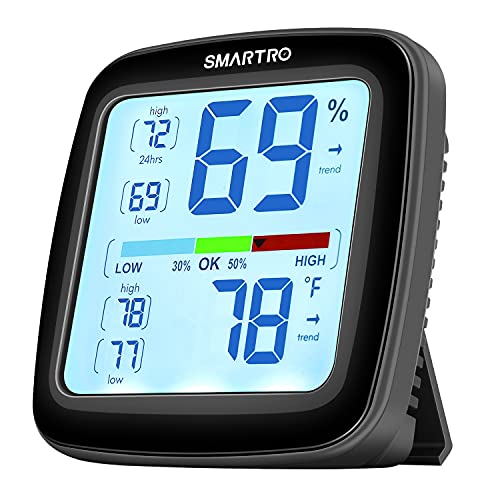
$12.99 Check pricePrices change often - SMARTRO
SMARTRO SC42 Professional Digital Hygrometer Indoor Room Thermometer
$18.99 Check pricePrices change often - TempPro
TempPro TP49 3 Pack Digital Hygrometer Indoor Thermometer
$20.89 Check pricePrices change often



Common questions
What is the ideal indoor humidity level year-round?
The general target is 30 to 50 percent relative humidity for most homes most of the year, though the safe ceiling drops further in cold weather to avoid window condensation. There is no single fixed ideal number that applies in every season and climate; the band is the practical target, adjusted downward as outdoor temperature drops.
Why does condensation form on windows in winter even when the house does not feel humid?
Condensation forms when indoor humid air contacts a cold surface and cools below its dew point right at that surface, and window glass runs much colder than room air in cold weather. A humidity level that feels normal and does not condense on interior walls can still condense on glass, since the window surface is the coldest point the air touches.
Can a humidifier and a dehumidifier be needed in the same house at the same time?
Yes, in different rooms with different conditions, such as a dry upstairs bedroom during winter heating season alongside a damp basement year-round. The two problems do not cancel each other out at the house level; each room’s actual humidity, measured with a hygrometer, determines which machine, if either, that specific room needs.
Does running a humidifier too much cause mold?
It can, if it pushes relative humidity above the 50 to 60 percent range for a sustained period, since that is the condition mold needs to grow. A humidifier set to maintain the middle of the 30 to 50 percent band, monitored with a hygrometer rather than run on an arbitrary fixed setting, avoids pushing a room into that higher-risk range.
How often does a dehumidifier need its tank emptied or a drain hose used?
It depends entirely on how damp the space is and the unit’s tank size; a persistently wet basement can fill a tank daily, while a mildly damp room fills much less often. A continuous drain hose to a floor drain or sump removes the emptying task entirely and is worth using in any space damp enough to fill a tank more than once every few days.
Is an evaporative humidifier better than an ultrasonic one for a dry room?
They solve the same direction of problem differently: evaporative units use a wick and natural evaporation, which self-regulates somewhat and avoids the fine mineral dust ultrasonic units can produce with hard water, while ultrasonic units run quieter and often cover smaller rooms well. The choice depends more on room size, noise tolerance and local water hardness than on one being universally better.