Ideal indoor humidity levels
Quick answer
Indoor relative humidity should sit between 30 and 50 percent; above 60 percent creates conditions that support mould growth and dust mite populations, and in cold weather, high indoor humidity condenses on windows and cold surfaces well before it reaches that 60 percent mark.

Govee Indoor Hygrometer Thermometer H5075 with Bluetooth App Control
A Bluetooth hygrometer like this one is the only way to know the actual number in a specific room rather than guessing from how the air feels, and checking it is a five second habit once it is on the wall.
Coverage claims vary in what air change rate they assume, so check a published airflow figure against your own room rather than the room size on the box.
| Range | Condition | What it supports |
|---|---|---|
| Below 30 percent | Too dry | Dry skin, irritated sinuses, static, cracking wood furniture |
| 30 to 50 percent | Target range | Comfortable and does not support mould or dust mite growth |
| 50 to 60 percent | Getting damp | Approaching conditions that favor mould and dust mites |
| Above 60 percent | Too damp | Supports mould growth and dust mite populations |
Why 30 to 50 percent is the target range
This range balances two failure modes. Below 30 percent, air is dry enough to irritate skin and sinuses, increase static electricity, and dry out wood furniture and flooring over time. Above 50 percent, conditions start moving toward supporting biological growth, and past 60 percent, mould and dust mites both find the air reliably hospitable. The 30 to 50 percent band sits between those two problems.
This is guidance commonly cited by health and building organizations rather than a single universal physical threshold; some sources tighten the upper bound to 45 percent for households especially sensitive to mould or dust mite allergens.
The target range is also a moving one across the year for most homes rather than a number to hold perfectly fixed. Winter heating tends to dry indoor air well below 30 percent in many climates, while summer humidity, especially without air conditioning running, can push well above 50 percent. Tracking the number through the year, rather than checking once and assuming it holds, catches both seasonal swings before they become a persistent problem, and a household in a climate with a sharp seasonal swing often ends up needing both a humidifier for winter and a dehumidifier for summer, rather than one appliance covering the whole year.
What actually happens above 60 percent
Mould spores are present in nearly all indoor air in small numbers; what changes above roughly 60 percent relative humidity is that surfaces, especially in bathrooms, basements, and closets with poor air circulation, retain enough moisture for those spores to actually establish and grow rather than remaining dormant. Dust mites, a common allergy trigger, also thrive specifically in humid conditions above this threshold and decline when humidity drops back into the 30 to 50 percent range.
This is a description of physical conditions that support growth, not a claim about a specific reader’s allergy or respiratory symptoms; the measurable fact is the humidity level and its known relationship to mould and dust mite biology, not a promise about outcomes.
Sustained high humidity also affects the building itself over time, separately from the mould and dust mite question. Wood flooring, door frames, and window sills exposed to persistently damp air can swell, warp, or develop condensation-related staining well before visible mould appears, which is a separate, purely structural reason to keep a room within the target range even in a household with no particular allergy concern.
The cold weather condensation ceiling
In cold weather, the relative humidity a home can sustain indoors without condensation forming on windows and cold surfaces drops well below the general 60 percent warning line. Cold glass and cold exterior wall surfaces cool the air touching them below its dew point at a lower indoor humidity reading than warmer surfaces would, so a home running comfortable 45 percent indoor humidity in a warm season can see window condensation at the same 45 percent reading once outdoor temperatures drop.
Persistent window condensation in cold weather is a practical, visible signal to lower indoor humidity, even if a hygrometer reading is still technically inside the general 30 to 50 percent target range, because the effective ceiling for avoiding condensation depends on outdoor temperature as well as the indoor number.
Older single-pane windows and poorly insulated exterior walls have colder surface temperatures than newer double or triple-pane windows and well-insulated walls at the same outdoor temperature, which means the safe indoor humidity ceiling for avoiding condensation is not the same for every home; a newer, better-insulated home can often sustain a higher indoor humidity reading in cold weather before condensation appears than an older home with single-pane windows.
How to actually check your number instead of guessing
A standalone digital hygrometer is inexpensive and removes the guesswork; humidity is not reliably judged by how air "feels," since temperature affects that perception independently of actual moisture content. Placing a hygrometer in the specific room of concern, rather than relying on a single whole-house reading, matters because basements and bathrooms commonly run meaningfully more humid than the rest of a home.
Many combined air quality monitors also report humidity alongside particle and gas readings, covered in `/guides/reading-an-air-quality-monitor/`, though a dedicated hygrometer is the simpler and cheaper option if humidity is the only thing being tracked.
A Bluetooth or WiFi-connected hygrometer that logs readings over time has a practical advantage over a simple analog dial: it captures the overnight or workday humidity swing a household would otherwise miss by only checking once when someone happens to be home, which matters specifically for catching a slow, sustained drift into the too-humid or too-dry range rather than a single spot check that happens to land in the middle.
Bringing humidity back into range in either direction
A room reading persistently above 50 to 60 percent needs a dehumidifier sized to its square footage and moisture load; `/tools/dehumidifier-calculator/` and `/humidity/dehumidifier-300-square-feet/`-style sizing pages cover matching pint capacity to room size. A room reading persistently below 30 percent, common in winter with forced-air heating running, needs a humidifier rather than a purifier, since a purifier has no mechanism to add or remove moisture from the air; `/tools/humidifier-calculator/` covers that sizing separately.
A household correcting a too-dry winter reading should also watch the same cold weather condensation ceiling covered above: raising indoor humidity to the middle of the 30 to 50 percent range is generally safe, but pushing it toward the upper end of that range during a cold snap can trigger the same window condensation problem a too-humid room causes in summer, just from the opposite direction.
Why humidity varies so much room to room in the same house
Bathrooms and kitchens generate moisture directly through showers and cooking, which pushes their local humidity well above a whole-house average during and immediately after use. Basements sit closer to the ground and often have less air circulation and cooler surface temperatures than upper floors, both of which push relative humidity higher for the same absolute moisture content in the air. A bedroom on an upper floor, farther from these moisture sources and generally warmer, often reads noticeably drier than a ground-floor living space in the same house on the same day.
This is the practical reason a single whole-house humidity reading, from a thermostat display or a single hygrometer near the front door, can miss a real problem developing in a specific room. A basement running at 65 percent relative humidity while the main living area reads a comfortable 45 percent is a common pattern, and it only becomes visible by placing a hygrometer directly in the basement rather than trusting a single reading taken elsewhere in the house to represent the whole building.
Equipment mentioned on this page
- TempPro
TempPro TP50 Digital Hygrometer Indoor Thermometer Room Thermometer
$12.99 Check pricePrices change often - SMARTRO
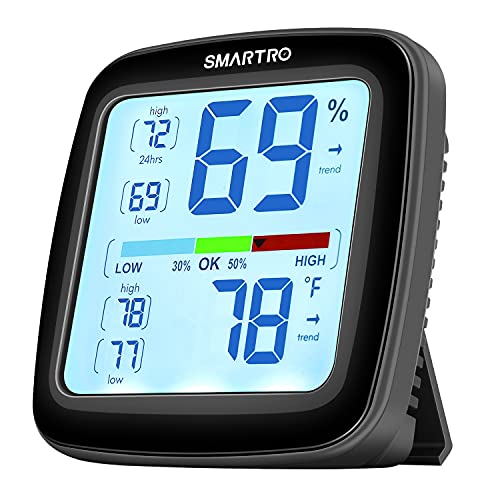
SMARTRO SC42 Professional Digital Hygrometer Indoor Room Thermometer
$18.99 Check pricePrices change often - TempPro
TempPro TP49 3 Pack Digital Hygrometer Indoor Thermometer
$20.89 Check pricePrices change often



Common questions
What is the ideal humidity level for a home?
Between 30 and 50 percent relative humidity is the commonly cited target range for a home. Below 30 percent, air tends to feel dry and irritate skin and sinuses; above 50 to 60 percent, conditions start favoring mould growth and dust mite populations.
What humidity level causes mould growth?
Mould growth is generally associated with relative humidity above roughly 60 percent, particularly on surfaces in poorly ventilated spaces like bathrooms, basements, and closets. Mould spores are present in nearly all indoor air already; sustained high humidity is what allows them to actually establish and grow on a surface.
Why is my window fogging up even though my humidity reading looks normal?
Cold glass cools the air touching it below its dew point at a lower humidity reading than warmer indoor surfaces require, so window condensation can appear at a humidity level, such as 45 percent, that would not cause condensation in warmer weather. This is the cold weather condensation ceiling, and it drops as outdoor temperature drops.
Do dust mites actually need high humidity to survive?
Yes. Dust mites, a common household allergy trigger, thrive specifically in humid conditions and decline when relative humidity drops into the 30 to 50 percent range. This is a measurable relationship between humidity and dust mite biology, not a claim about any individual’s allergy symptoms.
How do I measure the actual humidity in my home?
A standalone digital hygrometer, placed in the specific room of concern, gives an accurate reading in seconds and is the most reliable way to know the actual number rather than judging by how the air feels, which is affected by temperature independently of moisture content.
Can an air purifier fix humidity that is too high or too low?
No. A purifier filters particles from the air and has no mechanism to add or remove moisture. A room that is too humid needs a dehumidifier, and a room that is too dry needs a humidifier; these are separate appliances from an air purifier, addressing a different measurement entirely.