Best air purifiers for pollen and dust mite allergies
Quick answer
True HEPA filtration reduces the airborne concentration of pollen and dust mite debris when sized to 4 to 5 air changes an hour; the Honeywell Allergen Plus 4-in-1 (B0GZWX6W7V, $159.99) covers about 1,718 square feet at the manufacturer’s claim.
Four to five air changes an hour is guidance for allergy households, not a measured threshold, and none of the figures on this page describe a health outcome or a symptom result.

Honeywell Allergen Plus 4-in-1 HEPA Air Purifier for Home, Up to 1718 Ft2 Coverage for Large Rooms, Reduces Allergens, Pet Dander, Smoke & Odors, Air Quality Sensor with Auto Mode, White, HPA4300W
The Honeywell Allergen Plus 4-in-1 pairs true HEPA with a carbon stage and a particle sensor with auto mode, so it ramps up automatically when pollen or dust events spike rather than needing manual adjustment.
Coverage claims vary in what air change rate they assume, so check a machine's published airflow against your own room rather than the room size on the box.
The three tiers
Beginner: Best first allergy purifier
Who it is for: one bedroom during a pollen season
- Beginner pick
Clorox Medium Room Air Purifiers for Bedroom Home, True HEPA Filter
- HEPA claimed
- particle sensor
- auto mode
$139.95 Check pricePrices change often

The Clorox Medium Room true HEPA purifier (B09P1TRMHL, $139.95) includes a particle sensor and auto mode at a 225 square foot claim, small but consistent with a single bedroom during a heavy pollen stretch.
Not for: a shared living space or a whole floor
Intermediate: Best for dust mite debris in a shared room
Who it is for: a living room or bedroom shared by more than one allergy sufferer
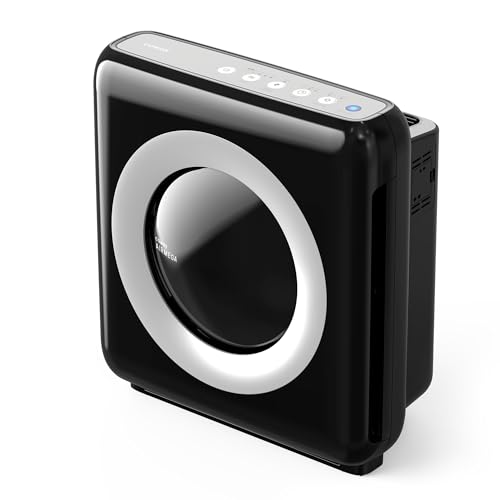
The Coway AP-1512HH (B00BTKAPUU, $218.50) is a long-running allergy pick with a washable pre-filter ahead of true HEPA, useful because dust mite debris and skin flakes are coarser than pollen and load up a pre-filter fast. Its claim is 1,748 square feet.
Not for: anyone who wants the newest generation of the same design
Expert: Best for a whole-home allergy season
Who it is for: a large open living area or multiple connected rooms
- Expert pick
PuroAir 400 HEPA Air Purifiers for Home Large Room Pets Filter 2,000 Ft2
- HEPA claimed
- carbon stage
$259.99 Check pricePrices change often
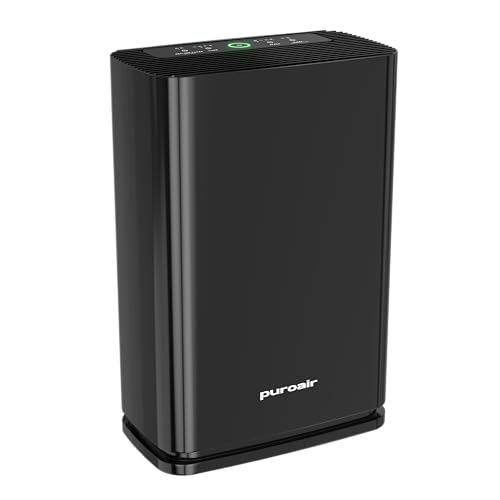
The PuroAir 400 (B0C3FXZLZ5, $259.99) combines true HEPA and carbon in a 2,000 square foot claim, sized for open-plan spaces where pollen tracked in at one door needs to be captured before it spreads through the whole floor.
Not for: a single small room, where it is oversized for the cost
| Tier | Coverage claim | Pre-filter or carbon |
|---|---|---|
| Beginner (B09P1TRMHL) | 225 sq ft | True HEPA, sensor, auto mode |
| Intermediate (B00BTKAPUU) | 1,748 sq ft | Washable pre-filter + true HEPA |
| Expert (B0C3FXZLZ5) | 2,000 sq ft | True HEPA + carbon |
| Top pick (B0GZWX6W7V) | 1,718 sq ft | True HEPA + carbon + sensor |
What does an air purifier actually do for pollen and dust mite debris?
A true HEPA filter mechanically captures airborne particulate as it passes through the media, including pollen grains and the fragmented waste particles from dust mites that trigger allergy symptoms in sensitive people. The purifier reduces the measured airborne concentration of those named particles in the room where it runs.
That is a specific, testable claim, and it is the only kind made on this page. Filtration does not treat, cure or relieve allergies as a medical condition; it lowers how much of a particular particulate is suspended in the air a person is breathing, which is a different and more limited statement than any claim about symptoms improving.
Why 4 to 5 air changes an hour for allergy households?
Four to five air changes an hour is guidance commonly used for allergy-sensitive households, not a result from a specific published study measuring symptom outcomes at that rate. It sits above the general comfort range and below the 6 air changes an hour this site recommends for active smoke sources, reflecting that pollen and dust mite debris settle and re-suspend rather than continuously entering a sealed room the way smoke does during an active event.
Required CADR in CFM is floor area times ceiling height times air changes an hour, divided by 60. A 300 square foot living room with an 8 foot ceiling at 5 air changes an hour needs 300 x 8 x 5 / 60, which is 200 CFM of relevant CADR, in this case the pollen or dust CADR figure rather than smoke. Dropping to 4 air changes an hour for the same room lowers that requirement to 160 CFM, which is the low end of the guidance range this page uses.
Pollen versus dust mite debris: does the same filter handle both?
Yes, in the sense that true HEPA media captures both at high efficiency once particles reach the filter. The practical difference is upstream: dust mite waste and skin flake debris tend to be part of coarser household dust that settles on surfaces and gets stirred up by movement, while pollen is tracked in from outside on clothing, pets and open windows.
A washable pre-filter, present on the Coway AP-1512HH in the Intermediate tier, is useful against the coarser dust mite debris because it catches larger particles before they load the true HEPA stage, extending the HEPA filter’s working life in a household with heavy dust. Pollen alone is generally light enough to reach the HEPA stage regardless of whether a pre-filter is present, so the pre-filter’s biggest benefit here is specifically against dust mite debris and everyday household dust.
What is the two-thirds rule, and is it the same as the AHAM standard?
AHAM AC-1 is the published test standard behind a purifier’s CADR numbers, measured in a sealed 1,008 cubic foot chamber. The two-thirds rule, CADR at least two-thirds of the room’s floor area, is a separate shopper’s convention that pre-fills an 8 foot ceiling and 5 air changes an hour into that same arithmetic: 8 x 5 / 60 works out to 0.667.
For a 300 square foot room, the two-thirds convention says a CADR of at least 200 is enough, which matches the 200 CFM calculated directly above. The convention is a fast shortcut for exactly this guidance-level air change rate; it is not itself a tested standard the way AHAM AC-1 is, and it should not be confused with a claim about allergy symptom outcomes at that particular figure.
Does a HEPA filter’s square footage claim need adjusting for allergies?
Less than it does for smoke, since allergy guidance and the common manufacturer assumption both cluster around 5 air changes an hour. A claim built on a slower rate, closer to 2 or 3 air changes an hour, will still overstate real allergy-relevant coverage, the same way a 500 square foot claim at 2 air changes an hour becomes about 200 square feet at 5.
Where a listing states the air change rate behind its coverage claim, checking it against the 4 to 5 range used here is worth the minute it takes. Where it does not state one, treating the printed square footage as an upper bound rather than a guarantee is the safer read, since a manufacturer has an incentive to publish the largest defensible number rather than the most conservative one.
How often does a HEPA filter need replacing for allergy relief to hold up?
A clogged HEPA filter loses airflow and, on a sensor-equipped unit, forces the fan to work harder for the same air exchange, or on a basic unit simply moves less air through the same filter. Manufacturer replacement intervals, typically six to twelve months for a moderate-use household, assume the filter is not carrying an unusual dust or hair load, and a household running the unit continuously for allergy control will generally sit toward the shorter end of that window.
A household with heavy dust, pets or nearby construction should plan on the shorter end of that range or sooner. None of the picks on this page were tested in person for filter life; the intervals referenced here come from published manufacturer guidance, not owner measurement done by this site.
Does room placement matter, and should an allergy purifier run continuously?
Placement affects how quickly air actually reaches the filter, regardless of the unit’s rated CADR. A purifier pushed into a corner or blocked by furniture on two sides draws in less air per minute than the same unit placed with clearance on all sides, effectively lowering its real-world air changes an hour below what the arithmetic in the sections above assumes, even though the unit’s printed CADR number has not changed at all.
For an allergy-focused placement specifically, positioning the unit closer to where pollen enters, such as near a frequently used entry door or a window left open during mild weather, or near a bed if dust mite debris in bedding is the main concern, gets ahead of the allergen at its most concentrated point rather than waiting for it to disperse through the whole room first. This site’s placement guide covers the general clearance rules a purifier needs regardless of the specific allergen being targeted.
Running continuously keeps the airborne concentration of pollen and dust mite debris lower on average, since both particle types are constantly settling and re-suspending from surfaces, furniture and bedding rather than arriving in a single burst. Switching a unit on only when symptoms are already noticeable means the room’s particulate load has already climbed before the purifier starts working it back down, and bringing that level back down again takes real time at any realistic air change rate.
A sensor-equipped unit with auto mode, like the top pick and the Beginner tier pick on this page, makes continuous operation more practical by dropping fan speed and noise during low-particulate stretches and ramping up automatically when a window opens or dust gets stirred up, rather than running at a single fixed speed around the clock through the night and during the day alike.
How we chose
Every product on this page was researched from published manufacturer specifications and CADR figures where listings state them, along with owner reports on retail listings, not from in-person or lab testing.
Selection prioritized true HEPA media, a stated coverage claim that still holds up at 4 to 5 air changes an hour, and, where relevant, a washable pre-filter or carbon stage suited to dust mite debris and pollen specifically rather than smoke.
Buying tips
Does a higher CADR number always mean better allergy relief?
A higher CADR means faster particulate removal at the tested particle size, which supports lower measured airborne concentration. It is not evidence about symptom relief, which this page does not claim for any product.
Is a sensor and auto mode worth paying for?
It is useful in a household with variable pollen exposure, since the unit ramps up automatically during a spike instead of needing a manual fan speed change. It is not necessary in a room with fairly constant allergen load.
Should I size for the room or the whole floor?
Size for the specific room where the allergy-sensitive person spends the most time, typically a bedroom, unless allergens are clearly spreading through an open floor plan, in which case a larger unit like the Expert tier pick makes more sense.
Other options worth knowing about
- MOOKA
MOOKA H13 HEPA Air Purifier for Home Pet Large Room Up to 1300ft2, Black
- HEPA claimed
- carbon stage
- has a UV lamp
$46.98 Check pricePrices change often - MOOKA
MOOKA Air Purifiers for Home Room up to 1076ft2, True HEPA Filter, B-D02L
- HEPA claimed
- carbon stage
$49.99 Check pricePrices change often - MOOKA
MOOKA Air Purifiers for Home Room up to 1076ft2, True HEPA Filter, B-D02L
- HEPA claimed
- carbon stage
$49.99 Check pricePrices change often - Clorox
Clorox Small Room Air Purifiers for Bedroom Home, True HEPA Filter
- HEPA claimed
$59.95 Check pricePrices change often - Afloia
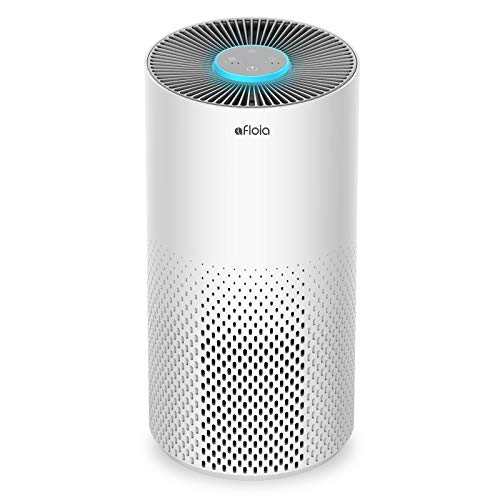
Afloia Air Purifier for Home Bedroom Large Room up to 1500 Sq Ft
- washable pre-filter
$59.97 Check pricePrices change often


Common questions
Can an air purifier cure or relieve seasonal allergies?
No claim like that is made on this page or should be trusted from any listing. A true HEPA purifier reduces the measured airborne concentration of pollen and dust mite debris in a room; it does not treat, cure or relieve allergies as a medical condition. Reducing airborne particulate is a different, more limited statement than a symptom outcome.
Why does this page recommend 4 to 5 air changes an hour for allergies?
That range is commonly used guidance for allergy-sensitive households, not a result from a study measuring symptom outcomes at a specific rate. It sits above general comfort levels and below the 6 air changes an hour this site recommends for active smoke sources, since pollen and dust mite debris settle and re-suspend rather than continuously entering a room.
What is the difference between the two-thirds rule and the AHAM CADR standard?
AHAM AC-1 is the published test standard that produces a purifier’s CADR numbers in a sealed chamber. The two-thirds rule, CADR at least two-thirds of a room’s floor area, is a separate shopper’s convention that assumes an 8 foot ceiling and 5 air changes an hour; it is a shortcut built on the standard, not a standard itself.
Does a washable pre-filter matter for allergies the way it does for pet dander?
It helps with dust mite debris and skin flake particles specifically, since those tend to be coarser than pollen and settle into household dust that a pre-filter can catch before it loads the true HEPA stage. It is less critical for pollen alone, which is generally finer and reaches the HEPA stage regardless.
Should I check the pollen CADR or the dust CADR for allergy shopping?
Either is relevant since both pollen and dust mite debris are captured by the same HEPA media, but a listing that states separate pollen and dust CADR numbers under AHAM AC-1 lets a shopper check the one closer to their specific concern. When only one CADR figure is listed without naming the particle, treat it as an approximate rather than exact match to either.
How often should a HEPA filter be replaced in an allergy-sensitive household?
Manufacturer guidance typically suggests six to twelve months for moderate use, but a household with heavy dust, pets or nearby construction should plan for the shorter end or sooner. A clogged filter loses airflow, which reduces the actual air changes an hour the unit delivers regardless of its original CADR rating.