How long to remove airborne particles at different air changes per hour
Quick answer
At 4.5 air changes per hour, a purifier removes 90 percent of airborne particles in about 31 minutes, and 99 percent in about 61 minutes. Doubling the air change rate cuts clearance time in half.

Frida Baby 3-in-1 Air Purifier, Sound Machine + Nightlight, Auto-Off Timer
A machine that publishes a real airflow figure, so the arithmetic on this page can actually be applied to it.
Coverage claims vary in what air change rate they assume, so check a published airflow figure against your own room rather than the room size on the box.
| ACH | 90% clearance | 99% clearance |
|---|---|---|
| 0.5 | 276 minutes (4.6 hours) | 552 minutes (9.2 hours) |
| 1 | 138 minutes (2.3 hours) | 276 minutes (4.6 hours) |
| 1.5 | 92 minutes (1.5 hours) | 184 minutes (3.1 hours) |
| 2 | 69 minutes (1.2 hours) | 138 minutes (2.3 hours) |
| 2.5 | 55 minutes | 110 minutes (1.8 hours) |
| 3 | 46 minutes | 92 minutes (1.5 hours) |
| 4 | 35 minutes | 69 minutes (1.2 hours) |
| 4.5 | 31 minutes | 61 minutes (1 hour) |
| 5 | 28 minutes | 55 minutes |
| 6 | 23 minutes | 46 minutes |
| 8 | 17 minutes | 35 minutes |
Understanding air change rate and particle clearance
Air change rate (ACH) is how many times per hour all the air in a room is completely replaced. At 4.5 ACH, the air is fully exchanged 4.5 times per hour, or every 13 minutes.
But complete air exchange does not mean all particles are removed. Some particles are in the air, some have settled on surfaces. Purifier efficiency depends on airflow, filter quality, and mixing patterns in the room. The worst-case assumption for clearance time is that the purifier is the only removal path.
In a well-mixed room with a purifier running, particles are removed exponentially, not linearly. The first 90 percent takes less time than the last 9 percent, because the remaining particles are harder to find and catch.
Factors that affect real clearance time
- Room mixing: if the purifier is in a corner and pollution is on the opposite side, mixing is slower
- Particle settling: large particles settle fast and do not need to be "cleared" as much
- Continuous pollution: if a source is active (cooking, smoking), new particles enter faster than the purifier removes them
- Filter loading: as the filter fills with dust, airflow drops and clearance time increases
The math: exponential decay formula
The formula is t = ln(1 / (1 - fraction)) / ACH hours, where fraction is the percentage removed (0.9 for 90%, 0.99 for 99%).
This simplifies to: time in minutes = 138 / ACH for 90% removal, and 276 / ACH for 99% removal.
The formula assumes well-mixed air: the purifier intake sees representative air, not just purified air. This is why purifier placement matters. A purifier in the middle of a room mixes faster than one in a corner.
Low ACH: slow clearance, steady state takes hours
At 1 ACH (the minimum to reduce allergens), it takes 2.3 hours to clear 90 percent. At 0.5 ACH, it takes over 4.5 hours. This is why small purifiers in large rooms fall behind during acute pollution like cooking smoke.
Slow clearance also means that if the pollution source stays active (someone cooking for an hour), the indoor PM2.5 never drops. The purifier removes particles, but the stove adds more. Only after the source stops can PM2.5 decline.
Medium ACH: 4.5 ACH is the standard for allergy households
At 4.5 ACH (the AACVAI recommendation for allergies), 90 percent is cleared in 31 minutes, and 99 percent in 1 hour. This is practical for bedrooms: run the purifier for one hour before sleep to clear allergens, then run on low or turn off.
Four and a half ACH is the middle ground between cost and effectiveness. It is achievable with a moderate-size purifier in a typical bedroom or office, and the energy cost is acceptable for daily use.
High ACH: 6 to 8 ACH for acute events
At 6 ACH, 90 percent is cleared in 23 minutes. At 8 ACH, it is 17 minutes. This speed is useful during cooking events or when wildfire smoke is heavy: run the purifier on high for 30 minutes and capture most particles before they settle.
The cost of high ACH is higher energy use. Most purifiers on high draw 50 to 100 watts, which adds up if run all day. For acute events (cooking, smoke), high speed for 30 to 60 minutes is practical. For continuous operation, medium speed (3 to 4.5 ACH) is more cost-effective.
Why the last 9 percent is hard
Removing 90 percent of particles takes 31 minutes at 4.5 ACH. Removing the final 9 percent (reaching 99 percent) takes another 30 minutes. The exponential decay means that low concentrations are harder to clear.
This is why perfect air is not the goal. Reaching 95 percent in an hour is practical. Reaching 99.9 percent takes 3 hours and is rarely needed. The goal is to reduce PM2.5 below the moderate range (below 35 micrograms) before it causes discomfort.
Equipment mentioned on this page
- GoveeLife
GoveeLife Smart Air Quality Monitor with PM2.5 H5106, LED Display Wired
- app or voice
$45.99 Check pricePrices change often - Clorox
Clorox Small Room Air Purifiers for Bedroom Home, True HEPA Filter
- HEPA claimed
$59.95 Check pricePrices change often - Afloia
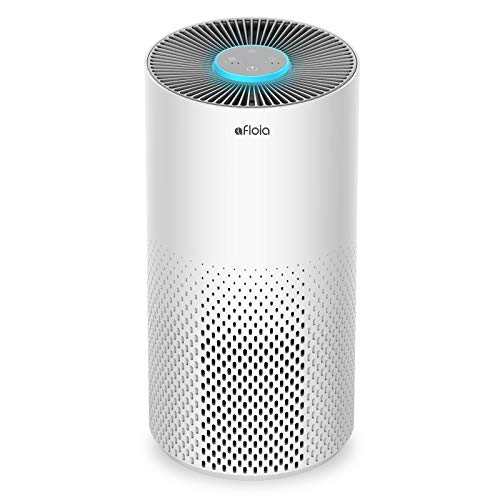
Afloia Air Purifier for Home Bedroom Large Room up to 1500 Sq Ft
- washable pre-filter
$59.97 Check pricePrices change often - Afloia
Afloia Air Purifier for Home Bedroom Large Room up to 1076 Sq Ft
$69.98 Check pricePrices change often




Common questions
Can I run my purifier on high all day?
You can, but the energy cost is high: 50 to 100 watts depending on the unit. Running on high for 1 to 2 hours after cooking or during heavy smoke events is practical. For background maintenance on moderate AQI days, running on low (1 to 2 ACH) is enough and costs much less.
My room does not clear to 90 percent in the time shown. Why?
The chart assumes perfect mixing and continuous operation. In real homes, air is not perfectly mixed: dead zones exist where particles do not reach the purifier intake. Continuous pollution (cooking, smoking) also adds new particles faster than the purifier removes old ones. These factors extend clearance time.
Does placing the purifier in the center of the room help?
Yes. A purifier in the center of a room mixes air faster than one in a corner or against a wall. Central placement reduces clearance time by 20 to 30 percent compared to corner placement. However, moving the intake away from walls can be impractical, so a corner placement with good intake design is acceptable.
What is "well-mixed" air?
Well-mixed means the purifier intake sees the same concentration as the whole room, on average. This happens when airflow is strong enough to push air around obstacles and reach all corners before returning to the intake. In a bedroom with doors closed and the purifier on high, mixing is usually good within 5 to 10 minutes.
Does settling count as particle removal?
Technically yes, but settiling is slow for small particles. PM2.5 can stay airborne for hours. For practical purposes, the purifier is the removal path. The settling contribution is often less than 10 percent, so the formula assumes the purifier does most of the work.