Humidifier output for 150 sq ft
Quick answer
Holding 150 square feet at 35 percent relative humidity when it is 20 degrees Fahrenheit outside takes roughly 0.52 gallons of water a day, assuming an eight foot ceiling and half an air change an hour of infiltration. On a milder 30 degree day, 40 percent is within reach and needs about 0.5 gallons, and in a zero degree cold snap the practical ceiling drops to 25 percent, which takes about 0.44. A room humidifier with a tank of a gallon or more can do that with one fill a day.
This is a water balance, not a rule of thumb: dry outside air arrives, is heated, and leaves carrying the moisture you added.
| Outdoor temperature | To hold 30 percent | To hold 35 percent | To hold 40 percent | To hold 45 percent |
|---|---|---|---|---|
| -10 F | condensation risk | condensation risk | condensation risk | condensation risk |
| 0 F | condensation risk | condensation risk | condensation risk | condensation risk |
| 10 F | 0.5 gal | condensation risk | condensation risk | condensation risk |
| 20 F | 0.42 gal | 0.52 gal | condensation risk | condensation risk |
| 30 F | 0.3 gal | 0.4 gal | 0.5 gal | condensation risk |
| 40 F | 0.14 gal | 0.24 gal | 0.35 gal | 0.45 gal |

Levoit Humidifiers for Bedroom, Quiet, 3L Cool Mist, Essential Oil Diffuser
Output in gallons per day is the figure to compare, and tank size is what decides how often you refill it rather than how much moisture it can add.
Put a hygrometer somewhere other than beside the machine. A humidifier reads the dampest air in the room by definition.
| Outdoor temperature | Practical indoor ceiling |
|---|---|
| -10 F | 20 percent |
| 0 F | 25 percent |
| 10 F | 30 percent |
| 20 F | 35 percent |
| 30 F | 40 percent |
| 40 F | 45 percent |
How much water does 150 square feet actually need?
The calculation is a water balance. Cold outside air arrives by infiltration at roughly half an air change an hour in an ordinary house, gets heated, and leaves carrying whatever moisture you have added. At 150 square feet and an eight foot ceiling that is 1,200 cubic feet of air, and holding 35 percent relative humidity against 20 degree outdoor air works out at about 0.52 gallons a day.
That figure is why tabletop humidifiers disappoint in large rooms. A one gallon tank in a space needing 0.52 gallons a day is adequate with one fill, and a machine that runs dry overnight is holding nothing by morning.
Why you cannot simply aim for 50 percent in winter
Warm humid air meeting cold glass makes water. The colder it is outside, the lower the indoor humidity has to stay to avoid condensation on the windows, and condensation on a window frame is how humidifying a house turns into mould in it.
The practical ceiling drops from about 45 percent at 40 degrees outside to about 25 percent at zero. Above that line the humidifier is not failing, it is succeeding in the wrong place: on the glass.
Tabletop, console or ducted
At 0.52 gallons a day a room humidifier with a tank of a gallon or more can hold this space with one fill a day. A console is more machine than the room needs, and a ducted unit only works while the furnace blower runs.
Whichever type, an accurate hygrometer somewhere other than next to the machine is what tells you whether it is working. The humidistat built into a humidifier reads the dampest air in the room by definition.
What the assumptions are, plainly
The figures assume an eight foot ceiling, half an air change an hour of infiltration, a house at 70 degrees Fahrenheit, and outside air at 70 percent relative humidity at the stated temperature. A draughty older house runs at a higher infiltration rate and will need more; a tight new build will need less.
Nothing here accounts for the moisture people, cooking and showers add, which in a small and well occupied home is not trivial. Treat the number as the size of machine to look for rather than as the amount of water you will actually use.
Humidifiers and a hygrometer to check the result
- TempPro
TempPro TP50 Digital Hygrometer Indoor Thermometer Room Thermometer
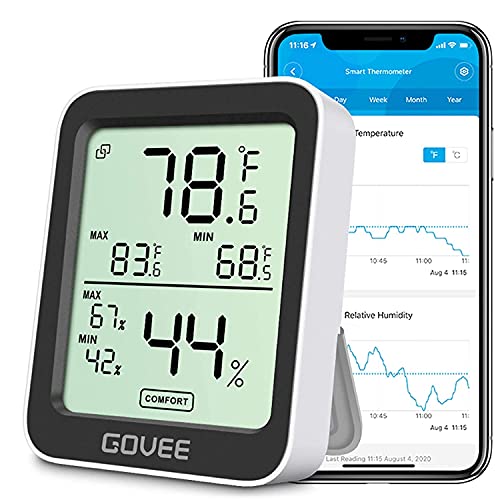
$12.99 Check pricePrices change often - Govee
Govee Indoor Hygrometer Thermometer H5075 with Bluetooth App Control
- app or voice
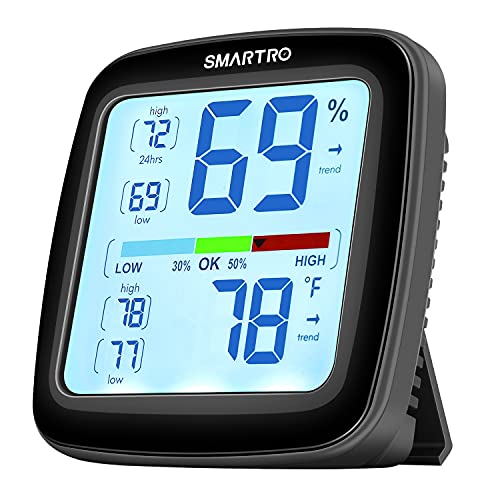
$12.99 Check pricePrices change often - SMARTRO
SMARTRO SC42 Professional Digital Hygrometer Indoor Room Thermometer
$18.99 Check pricePrices change often


Common questions
What size humidifier do I need for 150 square feet?
Roughly 0.52 gallons a day of output to hold 35 percent relative humidity against 20 degree outdoor air, with an eight foot ceiling. A room unit with a tank of a gallon or more covers that with a daily fill. Milder weather allows a higher target, and a colder snap forces a lower one because of condensation.
What humidity should I aim for indoors?
Between 30 and 50 percent relative humidity, and lower than that in cold weather to avoid condensation. Above 60 percent supports dust mites and mould growth. The cold weather ceiling is the binding constraint in most homes: at 20 degrees outside, about 35 percent indoors is as high as ordinary double glazing tolerates.
Why does my humidifier never reach the setting?
Usually because the output is smaller than the loss. Dry air is arriving continuously by infiltration and leaving with the moisture you added, so a machine with less output than that loss rate holds a lower humidity no matter how long it runs. The other common cause is a tank that empties overnight.
Do I need a filter or a wick?
Evaporative machines use a wick, which needs replacing as it stiffens with mineral scale, and that wick is what keeps minerals out of the air. Ultrasonic machines have no wick and will put dissolved minerals into the room as white dust unless you use distilled water. Neither type is wrong, but the running cost differs.
Can a humidifier make a house damp enough to cause problems?
Yes, and it is the common failure mode in cold weather. Condensation on windows, damp patches on cold exterior walls and mould in window frames are all signs the indoor humidity is above what the building can tolerate at that outdoor temperature. Lower the setting rather than trying to ventilate around it.