True HEPA vs HEPA-type: H13 and H14 standards, and what "99.9 percent" claims miss
Quick answer
True HEPA means 99.97 percent efficiency at 0.3 microns under a published standard. HEPA-type has no test requirement and is a marketing term. EN 1822 H13 meets HEPA at 0.3 microns; H14 is higher. Always check for a certification number, not just a label.
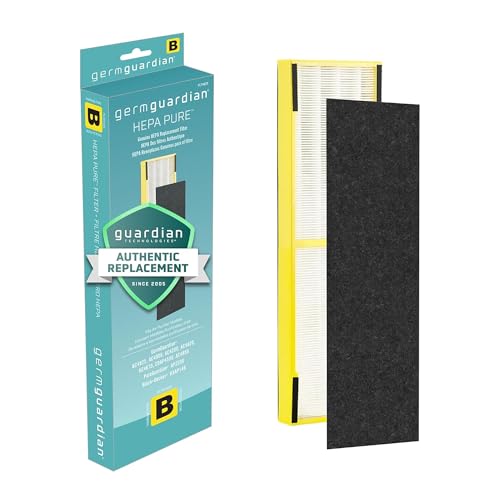
GermGuardian, Filter B HEPA Pure Genuine Air Purifier Filter, Removes 99.97% of Pollutants, Wildfire Smoke, Odors, for Ac4825, Ac4300, Ac4850, Ac4880, Ac4900, Cdap4500, Ap2200, Flt4825
A machine that publishes a real airflow figure, so the arithmetic on this page can actually be applied to it.
Coverage claims vary in what air change rate they assume, so check a published airflow figure against your own room rather than the room size on the box.
| Standard | Efficiency at 0.3 µm | Practical meaning | How to verify |
|---|---|---|---|
| HEPA (ASME B29.100) | 99.97% | True high-efficiency filter | Look for certification number or test report |
| HEPA (EN 1822) | 99.97% | Same as ASME, European test | Look for certification number |
| H13 (EN 1822) | 99.95% | Nearly HEPA; very high efficiency | Look for H13 label on filter |
| H14 (EN 1822) | 99.995% | Highest residential filter | Look for H14 label on filter |
| HEPA-type (no standard) | Unknown | Marketing term, no test required | Do not trust without independent test |
| 99.9% efficiency claim | Unknown percentage at 0.3 µm | Vague and unmeasurable; tested at what size? | Ask for the particle size and standard |
What true HEPA means and why 0.3 microns matters
HEPA stands for High-Efficiency Particulate Air, and the standard is defined by ASME B29.100 in the United States and EN 1822 in Europe. Both standards define HEPA as 99.97 percent efficiency at 0.3 microns.
The 0.3 micron size is chosen because it is the Most Penetrating Particle Size (MPPS) for fibrous filters. At this size, filters are at their worst performance: the particles are too small to be blocked by direct interception, but too large to be moved by diffusion. Particles larger or smaller than 0.3 microns are actually easier to capture.
A filter rated at 99.97 percent efficiency at 0.3 microns will perform better at other sizes. The standard guarantees worst-case performance, not average performance. This is why HEPA is the reference standard for all air purifier claims.
How HEPA filters trap particles
- Direct interception: particles follow airflow but are close enough to fibers to stick
- Impaction: large particles cannot follow air curves and hit fibers head-on
- Diffusion: very small particles bounce around randomly and hit fibers
- Electrostatic attraction: some fibers carry a charge that attracts particles
HEPA under US standard (ASME B29.100)
The US standard tests HEPA filters under ASME B29.100 using monodisperse aerosol particles at six sizes: 0.3, 0.5, 1, 2, 3, and 5 microns. The filter is rated at the size showing the lowest efficiency.
A true HEPA filter must achieve 99.97 percent or higher at all six sizes, with the worst-case at 0.3 microns. This means a HEPA filter performs at 99.97 percent or better across all common particle sizes.
Certification requires testing by an independent lab and documentation of the test results. If a purifier manufacturer claims HEPA, they should be able to provide a test certificate with a lab certification number.
HEPA under European standard (EN 1822: H13 and H14)
Europe uses EN 1822, which defines HEPA filters and also introduces intermediate classes: H10, H11, H12, H13, H14, and U15.
H13 is equivalent to HEPA: 99.95 percent efficiency at 0.3 microns. H14 is 99.995 percent (also called ULPA, Ultra-Low Penetration Air). H10 is lower and used for light commercial applications.
In the US market, a European H13 filter meets the HEPA standard. H14 is higher and is used in hospitals and laboratories. Both require certification and testing.
HEPA-type: a marketing term with no meaning
HEPA-type is not a standard. A manufacturer can use this term without testing the filter or meeting any efficiency requirement. A HEPA-type filter might be 80 percent efficient, or 95 percent, or 99 percent. The term makes no promise.
HEPA-type filters are often found in budget air purifiers marketed to buyers who do not know the difference between true HEPA and marketing language. The cost saving is small (a true HEPA filter might cost 20 to 30 dollars more), while the performance gap is large.
The "99.9 percent" claim and what it hides
Marketers sometimes claim "99.9 percent efficiency" without naming the particle size or standard. This is legally safer than claiming "HEPA" because they cannot be charged with false advertising if they do not define what they are testing.
A filter might be 99.9 percent efficient at 5 microns but only 95 percent at 0.3 microns. Or it might be 99.9 percent efficient at one airflow rate but only 90 percent at the actual operating rate. Without the standard and particle size, the number is meaningless.
Always ask the manufacturer: at what particle size and under what standard is the efficiency measured? If they cannot or will not answer, the claim is not trustworthy.
How to verify HEPA certification
Step one: look for the words "HEPA" or "H13" or "H14" on the filter or in the product description. Not HEPA-type, not HEPA-like, just "HEPA".
Step two: ask the manufacturer for a test certificate or certification number. A legitimate HEPA filter has been tested by an independent lab (like NAFA or TÜV) and has a certification number you can verify.
Step three: check the filter replacement model number. The replacement filter should also carry the HEPA certification. If the unit claims HEPA but the replacement filter does not, the purifier loses performance after the first filter.
Equipment mentioned on this page
- Borgodf
Borgodf B-D02L/M05 Replacement Filter for MOOKA B-D02L & M05 Air Purifier
- HEPA claimed
- carbon stage
$17.98 Check pricePrices change often - Sinnya
12020 11020 HEPA Replacement Filter for Clorox Air Purifier 11020 & 11021
- HEPA claimed
$19.66 Check pricePrices change often - Cabiclean
Blue Pure Replacement Filter for Blueair 411, 411+, 411 Auto Air Purifier
- carbon stage
$19.89 Check pricePrices change often - Clorox
Clorox Tabletop Air Purifier True HEPA Replacement Filter, 200 Sq. Ft.
- HEPA claimed
$19.99 Check pricePrices change often - Borgodf
2 Pack HP102 Replacement Filter Compatible with Shark HP102 Air Purifier
- HEPA claimed
- carbon stage
$21.37 Check pricePrices change often - Cabiclean
HPA300 HEPA Filter Replacement for Honeywell, Replace HRF-R3 & HRF-A300
- HEPA claimed
- carbon stage
$21.99 Check pricePrices change often


Common questions
Is HEPA-type as good as true HEPA?
No. True HEPA is tested to 99.97 percent at 0.3 microns under a standard. HEPA-type is a marketing term with no test requirement. A HEPA-type filter might be 85 percent efficient; there is no way to know without independent testing. True HEPA is worth the extra cost.
Are H13 and H14 the same as HEPA?
H13 is equivalent to HEPA under the European standard EN 1822: 99.95 percent at 0.3 microns, which meets the US HEPA definition of 99.97 percent. H14 is higher: 99.995 percent. Both are legitimate HEPA-grade filters.
Can I trust a purifier that claims HEPA but does not show a test certificate?
Probably not. A legitimate manufacturer will provide a test certificate on request. If they do not, they likely have not tested the filter independently. Ask for the certification number before buying.
Does HEPA remove viruses?
HEPA filters capture particles 0.3 microns and larger with 99.97 percent efficiency. Viruses like flu or COVID are 0.1 to 0.2 microns, smaller than HEPA's tested range. However, viruses travel in droplets and respiratory aerosols that are larger and will be captured. A HEPA filter provides protection but not immunity.
Why is the test size 0.3 microns and not smaller?
Because 0.3 microns is the Most Penetrating Particle Size for fibrous filters. At this size, filter performance is worst. Particles smaller or larger than 0.3 microns are easier to capture, so testing at 0.3 microns guarantees performance across all sizes.