Indoor air particle sizes: what air purifiers actually remove
Quick answer
Common indoor particles range from 0.1 to 100 microns: bacteria are 0.3 to 10 microns, pollen 10 to 100 microns, and cooking smoke as small as 0.1 microns. HEPA filters struggle most at 0.3 microns, the hardest size to capture.
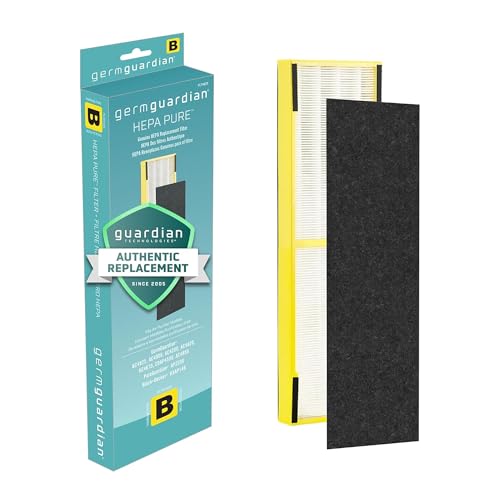
GermGuardian, Filter B HEPA Pure Genuine Air Purifier Filter, Removes 99.97% of Pollutants, Wildfire Smoke, Odors, for Ac4825, Ac4300, Ac4850, Ac4880, Ac4900, Cdap4500, Ap2200, Flt4825
A machine that publishes a real airflow figure, so the arithmetic on this page can actually be applied to it.
Coverage claims vary in what air change rate they assume, so check a published airflow figure against your own room rather than the room size on the box.
| Particle type | Size range (microns) | HEPA difficulty | Common sources |
|---|---|---|---|
| Pollen | 10 to 100 | Easy | Plants, flowers, trees |
| Mold spores | 3 to 40 | Easy | Damp areas, basements |
| Dust mite allergen | 10 to 40 | Easy | Bedding, furniture |
| Pet dander | 0.5 to 10 | Moderate | Cats, dogs, birds |
| Cooking smoke | 0.1 to 1 | Difficult | Stove, oven, fryer |
| Wildfire smoke | 0.1 to 1 | Difficult | Forest fires nearby |
| Bacteria | 0.3 to 10 | Very difficult | Air, surfaces, people |
Why particle size matters for filtration
Not all particles are the same size, and not all filters catch them equally. Size is measured in microns, where one micron is one millionth of a meter. A human hair is about 75 microns thick, which means most airborne particles are invisible without a microscope.
A filter works by trapping particles as air passes through. Larger particles are easier to catch because they cannot slip between the fibers. Smaller particles are harder to catch because they can follow the airflow around obstacles. There is a worst-case size called the Most Penetrating Particle Size, or MPPS, where a filter is at its least effective.
For HEPA filters, the MPPS is around 0.3 microns. This is why HEPA standards specify 99.97 percent efficiency at exactly this size: it is the point where the filter works hardest. Particles smaller or larger than 0.3 microns are actually easier to capture.
What each size range means
- Particles larger than 10 microns settle quickly on surfaces and are easiest for filters to remove.
- Particles from 1 to 10 microns stay airborne longer and require stronger airflow to capture.
- Particles smaller than 1 micron, including cooking smoke and wildfire smoke, stay suspended longest and demand maximum filter efficiency.
The difference between size and health impact
Particle size affects how deep into your lungs it travels. Large particles like pollen stop in your nose and throat. Medium particles like dust mite allergen reach the main airways. Very small particles like smoke and bacteria penetrate deep into the alveoli, where gas exchange happens.
This is why wildfire smoke is harder on people with asthma than pollen: the smaller the particle, the deeper it can reach. A purifier that removes small particles will also remove large ones, because the same filter medium works on both. The challenge is that removing small particles requires a filter dense enough to slow airflow, which is a trade-off in any unit.
How HEPA standards measure performance at different sizes
HEPA stands for High-Efficiency Particulate Air, and the standard is defined in EN 1822 for Europe and ASME B29.100 for the United States. The test uses a monodisperse aerosol, meaning all particles are exactly one size.
The test runs at six sizes: 0.3, 0.5, 1, 2, 3, and 5 microns. The filter is rated at whichever size shows the lowest efficiency. For most HEPA filters, that worst case is 0.3 microns, which is why 99.97 percent at 0.3 microns is the standard definition.
Real-world air is polydisperse: it contains a mix of sizes all at once. A filter tested at 0.3 microns will perform better at other sizes, so the 99.97 percent efficiency is the floor, not the ceiling. This standard is what allows HEPA filters to be the reference point for any air purifier claim.
Why not all particles are filtered out
Even a perfect HEPA filter removes 99.97 percent, which means 0.03 percent of particles pass through. In a room with continuous pollution from cooking or smoking, new particles enter faster than the filter can remove existing ones. The goal of air change rate is to run enough cycles to remove most particles, not all.
The other reason particles remain is that filters cannot catch particles that are not in the airflow. A filter in the corner removes only air flowing past it. If a source is on the opposite side of the room, that air has to travel, mix, and eventually reach the intake. This is why air purifier placement matters and why most people need more than one unit in a large home.
Monitor readings and what they measure
Air quality monitors usually report PM2.5 and PM10 concentrations. PM2.5 means particulate matter 2.5 microns and smaller, measured in micrograms per cubic meter of air. PM10 is 10 microns and smaller.
A PM2.5 reading of 35 micrograms per cubic meter is moderately unhealthy. The same reading at PM10 tells you nothing, because it includes pollen and dust that do not penetrate your lungs as deeply. This is why PM2.5 is the standard for indoor air quality guidance, and why many monitors show only PM2.5.
Equipment mentioned on this page
- Borgodf
Borgodf B-D02L/M05 Replacement Filter for MOOKA B-D02L & M05 Air Purifier
- HEPA claimed
- carbon stage
$17.98 Check pricePrices change often - Sinnya
12020 11020 HEPA Replacement Filter for Clorox Air Purifier 11020 & 11021
- HEPA claimed
$19.66 Check pricePrices change often - Cabiclean
Blue Pure Replacement Filter for Blueair 411, 411+, 411 Auto Air Purifier
- carbon stage
$19.89 Check pricePrices change often - Clorox
Clorox Tabletop Air Purifier True HEPA Replacement Filter, 200 Sq. Ft.
- HEPA claimed
$19.99 Check pricePrices change often - Borgodf
2 Pack HP102 Replacement Filter Compatible with Shark HP102 Air Purifier
- HEPA claimed
- carbon stage
$21.37 Check pricePrices change often - Cabiclean
HPA300 HEPA Filter Replacement for Honeywell, Replace HRF-R3 & HRF-A300
- HEPA claimed
- carbon stage
$21.99 Check pricePrices change often


Common questions
Can I see particles of 0.3 microns?
No. Human eyes see down to about 100 microns. The particles that make up smoke and wildfire haze are 0.1 to 1 micron, and bacteria are 0.3 to 10 microns. All are invisible without a microscope. Air quality monitors use light scattering to detect them instead.
Is HEPA-type the same as true HEPA?
No. True HEPA is tested under a standard and certified to remove 99.97 percent at 0.3 microns. HEPA-type is a marketing term with no test requirement. A HEPA-type filter might remove 80 percent, or it might remove 95 percent: the term makes no promise. Always check for a certification number, not just the label.
Why does cooking smoke look like fog but pollen does not?
Cooking smoke is mostly 0.1 to 1 micron, and particles that small scatter light and make air look cloudy. Pollen is 10 to 100 microns and settles quickly, so it does not make visible haze in the air. The size that scatters light best is around 0.5 microns, which is why smoke is so visible.
Do I need a different filter for each particle size?
No. One HEPA filter removes all sizes because the filter medium traps both small and large particles. A HEPA filter is actually harder on small particles, not easier. The trade-off is airflow: to catch very small particles, the filter must be dense, which slows the air passing through.
What removes bacteria that are 0.3 to 10 microns?
HEPA filters capture bacteria the same way they capture other particles. However, bacteria can also be killed by UV-C light if the purifier has that option. Neither method produces ozone. Ozone generators do kill bacteria, but California CARB restrictions apply because ozone harms human lungs.