True HEPA vs HEPA-type filters
Quick answer
True HEPA is a defined standard, 99.97 percent removal of particles at 0.3 microns, the hardest size to catch, while "HEPA-type" and similar phrases like "99.9 percent" carry no test requirement at all: a HEPA-type filter might remove 80 percent of particles or 95 percent, and the label alone does not tell you which.
Look for the words "true HEPA" or a stated efficiency at a stated micron size. Anything vaguer than that is a marketing term, not a test result.
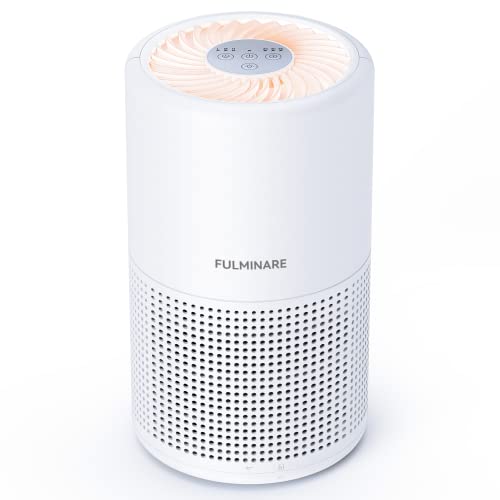
Air Purifiers for Bedroom, FULMINARE H13 True HEPA Filter
The FULMINARE is marked true HEPA on its listing at $24.99, a similar price point to HEPA-type alternatives, which shows the certified version is not automatically the expensive option.
Coverage claims vary in what air change rate they assume, so check a published airflow figure against your own room rather than the room size on the box.
| Label | Test requirement | Stated efficiency | Price on this comparison |
|---|---|---|---|
| True HEPA (FULMINARE) | Rated to the HEPA standard: 99.97% at 0.3 microns | 99.97% at 0.3 microns | $24.99 |
| HEPA-type (Homedics) | None: no standardized test requirement | Not independently stated | $34.99 |
Two nearly identical prices, two very different claims
Both units compared here are small, personal-scale purifiers aimed at a desk or a small bedroom, and both sit within ten dollars of each other: $24.99 for the FULMINARE and $34.99 for the Homedics. That price similarity is exactly what makes the labeling difference worth paying attention to, since a shopper comparing two similarly priced small purifiers has no obvious reason to assume one carries a tested certification and the other does not, until the specific wording on each listing is read closely.
This kind of near-identical pricing with a real underlying difference in what is actually being claimed is common across the budget end of the purifier market, which is exactly why relying on price as a proxy for quality or certification does not hold up under scrutiny.
What "true HEPA" is actually promising
True HEPA is not a brand name or a marketing flourish; it is a reference to a defined test standard. A filter tested to that standard must remove at least 99.97 percent of particles at 0.3 microns, the size known as the Most Penetrating Particle Size, where filters are at their statistical weakest. Particles larger or smaller than 0.3 microns are actually easier for the same filter to catch.
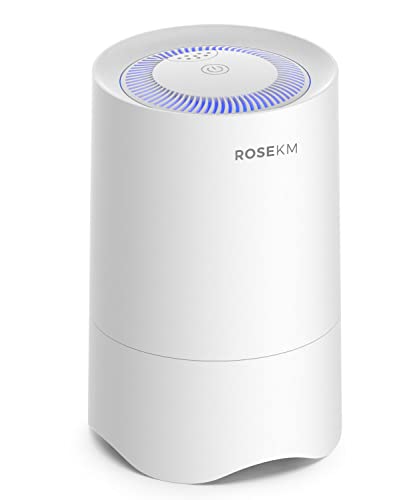
When a catalog listing marks a product true HEPA, it is claiming the filter media itself meets that 99.97 percent figure at that specific size. The FULMINARE purifier, priced at $24.99 and rated H13 true HEPA on its listing, makes exactly this claim, and H13 is one of the recognized true HEPA efficiency grades used in the filtration industry. The ROSEKM Small Air Purifier, priced even lower at $19.99, makes the same H13 true HEPA claim on its listing, showing that the certification shows up across a range of budget price points rather than only on a single specific product.
What "HEPA-type" actually promises, which is nothing specific
HEPA-type, along with phrases like "HEPA-like" or a bare "99 percent" or "99.9 percent" claim, is not tied to any required test. A manufacturer can put that phrase on packaging without submitting the filter to any efficiency test at any particle size. The Homedics Personal Air Purifier, priced at $34.99, is marketed explicitly with a "HEPA-Type Filter" on its listing, and its catalog entry marks true HEPA as false.
That does not mean a HEPA-type filter removes nothing. It might perform close to true HEPA levels, or it might remove a meaningfully smaller share of particles. The label alone gives you no way to know, because there is no test result the phrase is required to represent. Two different products both marked HEPA-type could sit at opposite ends of that performance range while carrying the exact same wording on their packaging, and a shopper has no way to tell the two apart from the box alone. Independent lab test results, where a brand publishes them voluntarily, are the only real substitute for the missing certification, but not every HEPA-type product offers one, and a claim without a linked test report is worth treating with the same caution as no claim at all.
Why the difference is not about price
It would be easy to assume true HEPA always costs more, but that is not what shows up here. The Homedics HEPA-type unit lists at $34.99, ten dollars more than the FULMINARE true HEPA unit at $24.99. Certification is not a premium feature reserved for expensive purifiers; some budget units genuinely carry it, and some pricier units still use vaguer language.
This is exactly why reading the specific claim on a listing matters more than judging by price point or brand recognition. A ten dollar difference in either direction tells you nothing about which filter is actually tested to a real standard, and a shopper who assumes the pricier option must be the certified one will get it backward exactly as often as they get it right.
Where the true HEPA standard actually comes from
The true HEPA definition traces back to test standards used in the United States and Europe: broadly, IEST-RP-CC001 and related ASME B29.100 methodology in the US, and EN 1822 in Europe. Both frameworks require testing at a monodisperse aerosol, meaning particles of a single controlled size, run through the filter media at six sizes including 0.3 microns, the size at which a filter is statistically weakest. A filter earns the true HEPA designation by meeting the required efficiency at its worst measured size, not its best.
A HEPA-type filter has never been run through that test at all, or if it has, the manufacturer is not required to disclose the result on the packaging. That is the entire practical difference: true HEPA is a pass or fail outcome from a defined test, and HEPA-type is a description with no test behind it whatsoever. The named grades, H10 through H14 in the European system, add a further layer of precision on top of a bare true HEPA claim, letting a buyer distinguish a merely adequate certified filter from one certified at a noticeably higher removal efficiency.
Why manufacturers use HEPA-type language in the first place
Submitting a filter for true HEPA testing and certification costs money and time, and not every manufacturer building a budget purifier chooses to do it, even when their filter media might perform reasonably well if it were tested. Using "HEPA-type" or similar language lets a brand suggest a HEPA-like association in the mind of a shopper without making a claim that could be checked against a specific test result.
This is not necessarily deceptive on its own: a brand that never claims true HEPA is not lying by using vaguer language. The problem for a shopper is that vaguer language provides no way to compare one HEPA-type filter against another, since neither has a published number attached, while two true HEPA filters can be compared on their stated efficiency and grade even across different brands.
What to actually look for on a listing
Look for the specific phrase "true HEPA" combined with a stated efficiency and micron size, ideally 99.97 percent at 0.3 microns, or a named grade like H13 or H14 from the European EN 1822 classification system. Those are specific, checkable claims tied to an actual test method.
Treat "HEPA-type," "HEPA-like," "99 percent efficient" without a stated particle size, or any similar soft language as unverified. It is not necessarily false advertising, since these phrases usually avoid claiming the specific HEPA standard outright, but it means you are trusting the general reputation of the brand rather than a checkable number.
Quick checklist before buying on a HEPA claim
- Does the listing say "true HEPA" specifically, not just "HEPA-type" or "HEPA-like"?
- Is there a stated percentage and a stated micron size, like 99.97 percent at 0.3 microns?
- Is there a named grade like H13 or H14, which refers to a specific tested efficiency tier?
- If none of the above are present, treat the HEPA language as a general description, not a test result.
Equipment mentioned on this page
- Borgodf
Borgodf B-D02L/M05 Replacement Filter for MOOKA B-D02L & M05 Air Purifier
- HEPA claimed
- carbon stage
$17.98 Check pricePrices change often - Sinnya
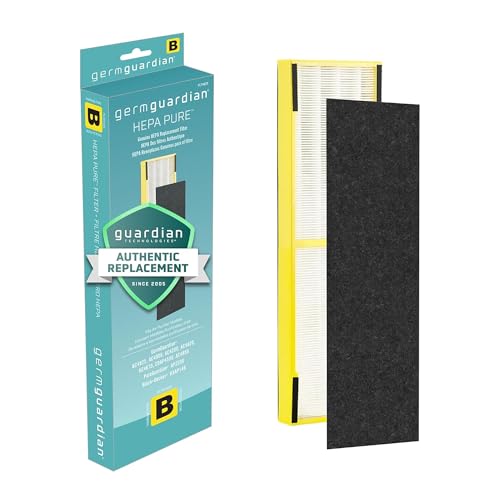
12020 11020 HEPA Replacement Filter for Clorox Air Purifier 11020 & 11021
- HEPA claimed
$19.66 Check pricePrices change often - Cabiclean
Blue Pure Replacement Filter for Blueair 411, 411+, 411 Auto Air Purifier
- carbon stage
$19.89 Check pricePrices change often - Clorox
Clorox Tabletop Air Purifier True HEPA Replacement Filter, 200 Sq. Ft.
- HEPA claimed
$19.99 Check pricePrices change often - Rosekm
ROSEKM Small Air Purifier for Bedroom & Desk, 50 Sq Ft, H13 HEPA, White
- HEPA claimed
$19.99 Check pricePrices change often




Common questions
Does HEPA-type mean the filter does nothing?
No. HEPA-type filters can still remove a meaningful share of airborne particles; the issue is that the phrase carries no required test, so there is no way to know the actual removal efficiency from the label alone. Some HEPA-type filters perform reasonably well, and others perform poorly, and the wording does not distinguish between them.
What does the 0.3 micron figure in the HEPA standard actually mean?
It refers to the Most Penetrating Particle Size, the size at which a filter is statistically weakest at catching particles. True HEPA filters are required to remove at least 99.97 percent of particles at exactly this size, which means their real-world performance at other sizes, both larger and smaller, is typically even better.
Is a higher price a reliable sign of a stated true HEPA specification?
No. In this comparison the HEPA-type unit costs more than the true HEPA unit, showing that price alone does not indicate certification. The only reliable indicator is the specific wording and stated test figures on the product listing itself.
What do H13 and H14 mean on a HEPA filter listing?
H13 and H14 are efficiency grades from the European EN 1822 HEPA classification system, with H14 removing an even higher percentage of particles than H13. Both are recognized true HEPA tiers, distinct from unregulated marketing language like HEPA-type.
Can a "99.9 percent" claim without a micron size still be trustworthy?
It is impossible to verify from that phrase alone. A percentage without a stated particle size does not tell you at what size that efficiency was measured, and removal efficiency varies enormously by particle size. True HEPA claims always pair the percentage with the 0.3 micron test point specifically.